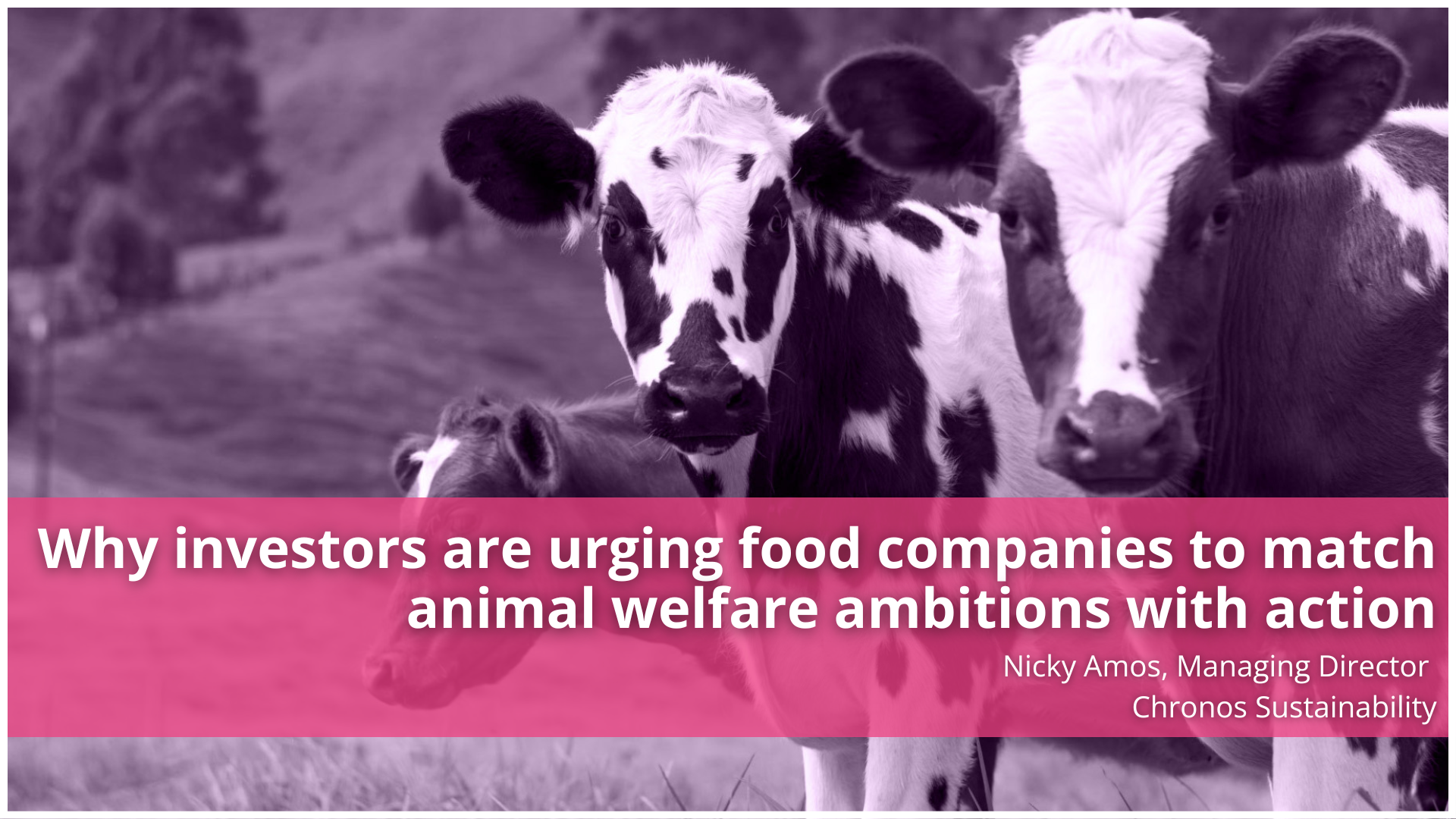
Why investors are urging food companies to match animal welfare ambitions with action
Nicky Amos, Managing Director, Chronos Sustainability

Note: The views expressed on these pages are the opinions of their respective author(s) only and do not necessarily reflect the views and opinions of UKSIF.
This website should not be taken as financial or investment advice or seen as an endorsement or recommendation of any particular company, investment or individual. While we have sought to ensure information on this site is correct, we do not accept liability for any errors.
Why investors are urging food companies to match animal welfare ambitions with action
Nicky Amos, Managing Director, Chronos Sustainability
Despite significant growth in animal agriculture – global meat consumption per capita has doubled since 1961 – investors remain concerned that not enough is being done to manage a risk at the heart of the industry’s future success. The need for high standards of farm animal welfare in our global supply chain is an issue that is not only about the wellbeing of animals, but essential to managing food security, human and environmental health risks.
The financial risks that stem from poor management of animal welfare include both reputational and regulatory issues, environmental pollution from animal waste and the risk of disease outbreaks – affecting both livestock and humans.
For example, almost 1.8 million farmed birds were culled in the UK in three months last year due to avian flu – a risk that can be exacerbated by intensive farming systems which typically feature high stocking densities and overcrowding. The livestock industry is also associated with the overuse of antibiotics which contributes to antimicrobial resistance – something the World Health Organization has identified as one of the top ten global public health threats facing humanity.
Encouraging food companies to manage these risks is one of the reasons investors tuned into the launch of the latest BBFAW (Business Benchmark on Farm Animal Welfare) report this week, hosted by BNP Paribas Asset Management – who are part of a $3 trillion backed investor coalition to support higher standards of farmer animal welfare. BBFAW ranks 149 leading food companies on animal welfare performance.
Results spotlights both progress and concerns
The report highlighted that the food sector was making uneven progress on animal welfare issues.
There are some signs of encouragement – including a decreasing reliance on cages across the world. There is, for example, a 4% year-on-year rise in the proportion of companies reporting progress toward achieving cage-free eggs, and in companies with targets to phase out farrowing crates for sows (small metal enclosures that prevent pregnant and nursing sows from turning around).
We’re also seeing a combination of regulation and technology addressing endemic issues such as the culling of day-old male chicks. Legislative changes in Germany, France, Italy, Austria and Luxembourg, and the European Union’s review of its animal welfare legislation, combined with technological innovations such as in-ovo sexing, which can detect the sex of a chick before hatching, are enabling companies to move toward eliminating this inhumane practice.
Ambition-action gap
These advances however are counter-balanced by the slow pace of implementation for several animal welfare commitments.
There are 96 companies that have set a target for laying hens in their supply chain to be cage-free, but BBFAW analysis shows that only 33 of these targets are universal in scope, covering all products and geographies, and only 17 companies have succeeded in eliminating cages from 100% of their supply chain.
There’s a similar story with the Better Chicken Commitment – an NGO-developed set of welfare requirements for broiler chickens. Of the 39 companies signed up to the Better Chicken Commitment, only 4 report that a substantial portion of their supply chain meets its three core requirements of lower stocking densities, slower-growing breeds and humane slaughter.
This year’s benchmark results show that while many companies have set a course toward a more compassionate, resilient and future-fit food system, progress remains too slow. This lack of delivery increases exposure to regulatory, reputational and financial risk, and may weaken investor confidence, alongside wider implications for consumers and for farmed animals.
For details on how to become a signatory of the BBFAW Global Investor Statement on Farm Animal Welfare or to join the BBFAW Global Investor Collaboration on Farm Animal Welfare, contact secretariat@bbfaw.com
The views expressed on these pages are the opinions of their respective author(s) only and do not necessarily reflect the views and opinions of UKSIF.
This website should not be taken as financial or investment advice or seen as an endorsement or recommendation of any particular company, investment or individual. While we have sought to ensure information on this site is correct, we do not accept liability for any errors.