Managing systemic climate risks and opportunities: why tipping points matter for long term investors
Charlie Young Ethical, Sustainable and Impact Researcher, Greenbank


Note: The views expressed on these pages are the opinions of their respective author(s) only and do not necessarily reflect the views and opinions of UKSIF.
This website should not be taken as financial or investment advice or seen as an endorsement or recommendation of any particular company, investment or individual. While we have sought to ensure information on this site is correct, we do not accept liability for any errors.
Managing systemic climate risks and opportunities: why tipping points matter for long term investors
Charlie Young Ethical, Sustainable and Impact Researcher, Greenbank
For decades, responsible investors have assessed climate risk through the lens of gradual linear change with incremental warming, steadily rising physical risks, and transition pathways that unfold smoothly over time. However, emerging Earth system science suggests this framing is no longer sufficient.
A growing body of research shows that the climate system does not always respond linearly. Instead, it can shift abruptly when critical thresholds are crossed, moving into new states that can be impossible to reverse. These shifts are known as climate tipping points, and they pose a fundamental challenge for long term investors.
At Greenbank, Rathbones’ specialist sustainable investment team, we have published a series of whitepapers exploring both negative and positive climate tipping points and what they mean for portfolio resilience, capital allocation and stewardship. This work is motivated by a simple observation, if markets continue to assume smooth, predictable change, they risk systematically under pricing some of the most material climate related risks and overlooking powerful sources of opportunity.
From gradual change to systemic shifts
Climate tipping points are critical thresholds beyond which environmental systems undergo irreversible, self-reinforcing changes, representing an underestimated risk in financial modelling. Negative climate tipping points are increasingly familiar in scientific literature.
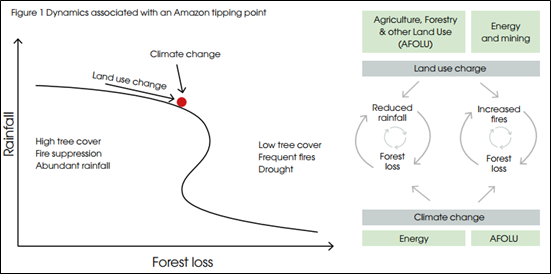
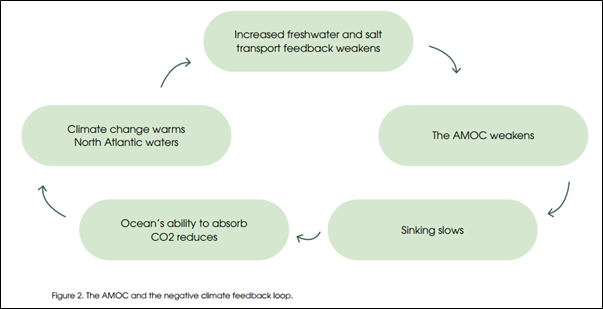
Examples include the potential collapse of the Atlantic Meridional Overturning Circulation (AMOC) which includes the Gulf Stream in its cycle, large scale dieback of the Amazon rainforest, or the irreversible loss of polar ice sheets. These events are typically low probability but high impact, with cascading effects across food systems, infrastructure, insurance markets and geopolitical stability.
What makes tipping points particularly challenging for investors is not just their severity, but their non linearity. Small changes in temperature, precipitation or land use can push systems past critical thresholds, triggering rapid and self reinforcing change within investable timeframes. Once crossed, these thresholds may lock in long term damage regardless of future mitigation efforts.
Original source: Marsden et al. (2024). Ecosystem tipping points: Understanding risks to the economy and financial system.
This perspective is gaining traction among leading climate-focused institutions. The Intergovernmental Panel on Climate Change (IPCC) and the Global Tipping Points Report have both highlighted that several Earth system components are showing early warning signals of destabilisation, even under current warming trajectories.
For long-term investors, this raises new questions. Many financial models still embed assumptions of stability, diversification and reversibility, yet tipping points challenge all three.
Why positive tipping points equally matter
While much of the discussion focuses on downside risk, an exclusive emphasis on negative tipping points risks missing half the picture.
Recent work by researchers including Professor Tim Lenton has highlighted the potential for positive tipping points, or self reinforcing shifts that accelerate decarbonisation once critical thresholds are reached. Examples include the rapid cost decline and adoption of renewable energy technologies, electric vehicles, or digital grid infrastructure that enables system wide flexibility.
These dynamics matter for investors because they can reshape markets far faster than linear forecasts suggest. Once a new technology or behaviour becomes cheaper, easier or more socially embedded than the incumbent, adoption can accelerate rapidly. Capital markets often underestimate the speed of these transitions, mispricing both incumbents and enablers.
By examining positive and negative tipping points together, we aim to understand not just where systemic risks may emerge, but where targeted investment, engagement or policy support can help shift systems onto more resilient pathways.
A systems lens for investors
Our research approach draws on systems thinking rather than single-issue analysis. Tipping points rarely occur in isolation; they interact through feedback loops that can amplify or dampen outcomes. For example, changes in ocean circulation can reshape weather patterns, with knock‑on effects for food systems, energy demand and migration. Likewise, accelerating clean energy adoption can reduce emissions, lower costs and strengthen political support, reinforcing the transition.
Produced by Greenbank.
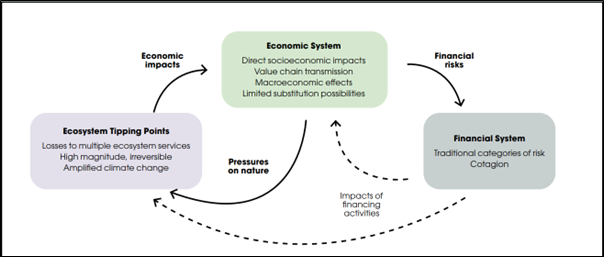
Destabilisation in one Earth system can therefore increase the likelihood of tipping elsewhere, creating cascading risks across regions and sectors. For investors, this means moving beyond asset by asset climate assessments towards a more integrated view of systemic exposure. It also means recognising that traditional risk tools may struggle to capture non linear dynamics.
Original source: Marsden et al. (2024). Ecosystem tipping points: Understanding risks to the economy and financial system.
There is no settled methodology for embedding tipping points into financial models, and we do not pretend otherwise, which is precisely why engagement with this area is necessary. Ignoring complexity because it is difficult to model is itself a risk.
Integrating tipping points into investment research
Through our series of whitepapers on climate tipping points, we aim to translate emerging Earth system science into insights that are relevant for investors today. Rather than predicting specific outcomes, the focus is on identifying where risks may be under appreciated, where opportunities may be accelerating, and how feedback loops could reshape markets over time.
Ultimately, resilience in investment portfolios depends on the stability of the systems that underpin economic activity. As climate change pushes those systems closer to critical thresholds, investors need frameworks that reflect this reality.
Tipping points are not a niche concern for climate scientists. They are a reminder that the future may arrive unevenly and faster than expected. For long term investors, recognising that possibility is the first step towards managing it.
You can visit our Insights Series page here to access the full climate tipping points reports, along with our other whitepapers to help you navigate the evolving landscape of sustainable investing.
The views expressed on these pages are the opinions of their respective author(s) only and do not necessarily reflect the views and opinions of UKSIF.
This website should not be taken as financial or investment advice or seen as an endorsement or recommendation of any particular company, investment or individual. While we have sought to ensure information on this site is correct, we do not accept liability for any errors.