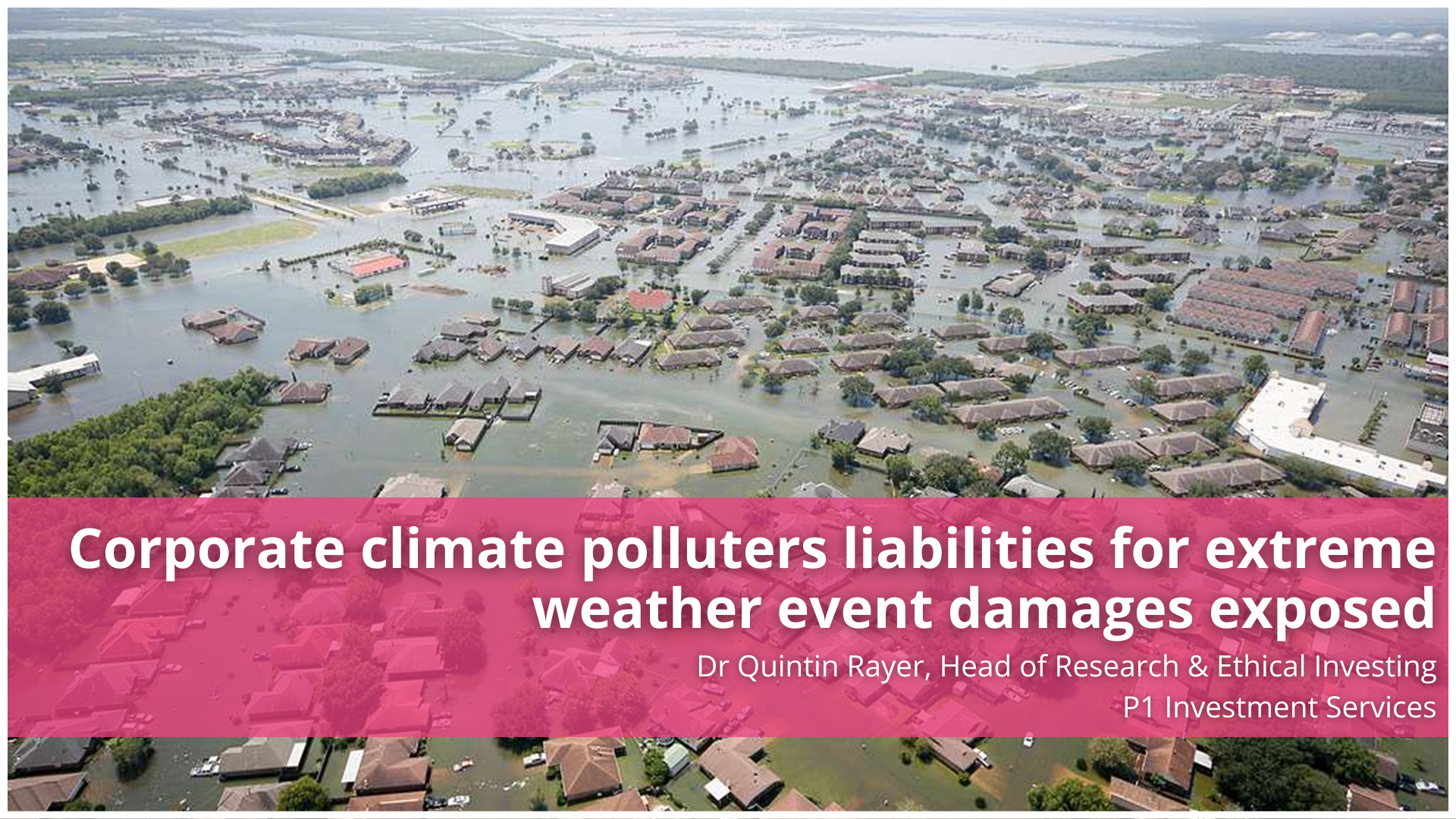
Corporate climate polluters liabilities for extreme weather event damages exposed
Dr Quintin Rayer, Head of Research & Ethical Investing, P1 Investment Services

Note: The views expressed on these pages are the opinions of their respective author(s) only and do not necessarily reflect the views and opinions of UKSIF.
This website should not be taken as financial or investment advice or seen as an endorsement or recommendation of any particular company, investment or individual. While we have sought to ensure information on this site is correct, we do not accept liability for any errors.
Corporate climate polluters liabilities for extreme weather event damages exposed
Dr Quintin Rayer, Head of Research & Ethical Investing, P1 Investment Services
New conceptual research provides an accessible pricing framework linking corporate values of high-emitting companies to the huge damages caused by extreme weather events.
Scientists have long known that emissions of carbon dioxide accumulate in the atmosphere, and together with other greenhouse gases, increase the likelihood of incredibly damaging extreme weather events. These include those leading to wildfires, life-threatening heatwaves, and the most intense hurricanes. Event damages can amount to hundreds of billions of US$ or more, with full damages from consequences being multiples of direct costs.
Our new conceptual research study, applies the emerging tool of emissions-based attribution from climate science and proposes an elegant and tractable framework linking individual company emissions to their extreme weather-related liabilities. Scientific climate attribution causally links emissions to extreme weather damages through three steps.
Firstly, firms’ activities emit greenhouse gases; that secondly, cause anthropogenic global warming; which thirdly, is linked to extreme weather by probabilistic attribution statements. Liabilities can therefore be attributed in a manner mirroring financial options.
The framework we propose is designed to be practical, combining academic rigor with commercial investment insights. A key strength is that it is accessible and straightforward to use by financial analysts, accounting and risk management professionals, policymakers, insurers and actuaries, for assessing climate risk exposures.
Climate scientists have long understood that carbon dioxide released to the atmosphere by extracting and burning underground carbon reserves takes exceedingly long times to return underground; geological timescales, over 10,000 years. Thus, such emissions effectively accumulate in the atmosphere and permanently change climate and weather patterns to increase probabilities of extreme weather events. This permanency of emissions’ atmospheric impacts means that firms’ climate polluting activities generate perpetual climate liabilities.
Beyond carbon dioxide accumulation, continuing emissions point to ongoing increases in extreme weather event frequencies, causing growing perpetual climate liabilities. For many extreme weather events, annual event probabilities increase linearly with increasing temperature, although past research has also suggested faster increases are possible. With global warming temperatures inexorably increasing ever higher from ongoing emissions, damages from extreme weather events should be treated as perpetual and with increasing frequency.
Our study estimates firms’ climate liabilities using a Gordon’s growth variant model. Under the innovative approach we develop, high-emitting firms’ exposures appear considerable, potentially 3% of market capitalisation from single events, implying similar reductions in stock value. We use scientific results to estimate extreme-weather-event liability growth rates. Our examples based on recent extreme weather events indicate liabilities growing at between 1.7% to 3.2% annually.
Comparing long-term discount rates with estimated climate liability growth rates shows the significant difficulties of hoping to outpace climate damages through economic growth which is accompanied by emissions. This insight is key for policymakers and our research includes allowance for societal responses to climate-damaging emissions.
Our novel and accessible approach to assessing climate liability costs can help stakeholders quantitatively estimate the corporate climate liabilities associated with emissions for risk management purposes. Governments can assess high emitting companies’ carbon cost implications when balancing against societal costs during policy design and considering assigning responsibility (and cost) to emitters. Accountants and analysts can explore company value sensitivities to extreme weather phenomena, emissions’ estimates and evolving societal positions on climate responsibility, including litigation. This will allow markets and decision-makers to better respond to corporate emissions’ regulatory or financial consequences.
Increasing transparency on emissions-related damages, may reduce societal acceptance of firms’ externalising emissions, perhaps through litigation, regulation or other measures. Consequently, following damaging extreme weather events, high-emitting firms’ valuations would better adjust to reflect their operations’ climate damages, stimulating transition to cleaner activities.
This research is published in the Journal of Applied Accounting Research:
Rayer QG, Andrikopoulos P (2026), “Extreme weather attribution: re-assessing company values using carbon emissions”. Journal of Applied Accounting Research, Vol. 27 No. 6 pp. 22–46, doi: https://doi.org/10.1108/JAAR-08-2024-0302
The views expressed on these pages are the opinions of their respective author(s) only and do not necessarily reflect the views and opinions of UKSIF.
This website should not be taken as financial or investment advice or seen as an endorsement or recommendation of any particular company, investment or individual. While we have sought to ensure information on this site is correct, we do not accept liability for any errors.