Companies are confronting the rise in physical risk head-on
Umar Ashfaq, Research Director, MSCI Institute


Note: The views expressed on these pages are the opinions of their respective author(s) only and do not necessarily reflect the views and opinions of UKSIF.
This website should not be taken as financial or investment advice or seen as an endorsement or recommendation of any particular company, investment or individual. While we have sought to ensure information on this site is correct, we do not accept liability for any errors.
Companies are confronting the rise in physical risk head-on
Umar Ashfaq, Research Director, MSCI Institute
Companies are approaching the costs of extreme weather and other hazards of a warming world with their eyes wide open.
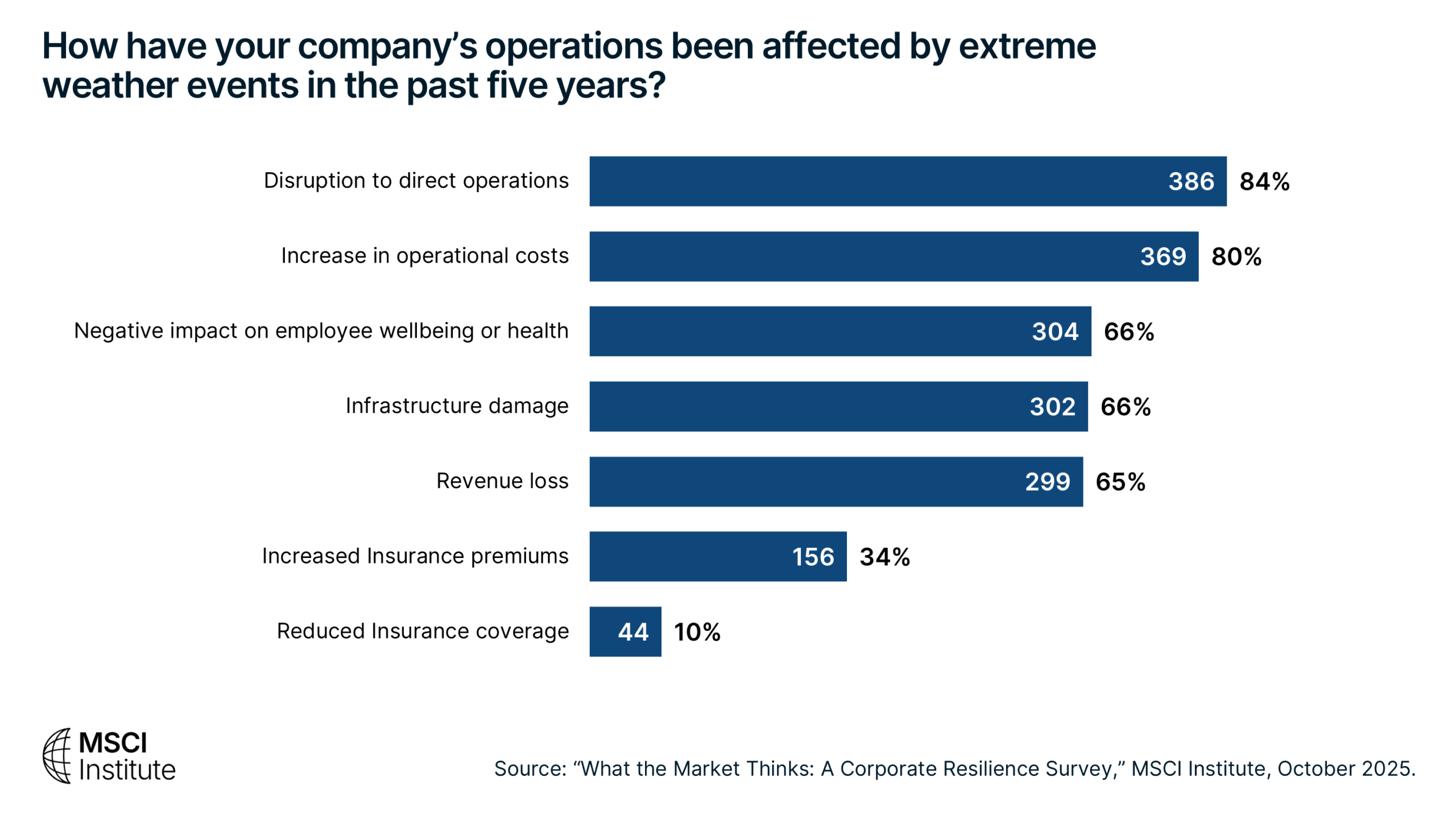
That’s among findings that come through a survey by our Institute that captures the views of risk, operations and finance officers at 550 listed and unlisted companies in 15 countries in the most physical-risk exposed industries. Among the findings:
- • More than 80% of companies surveyed say their operations and supply chains have been directly disrupted by extreme weather events such as severe storms, dangerous heat or flooding in the past five years.
• Companies that have been recently impacted by extreme weather events (32%) are twice as likely as companies not impacted (14%) to have completed infrastructure upgrades, highlighting how direct experience accelerates action.
• Nearly all (94%) of companies surveyed say they assess the risks of extreme weather, with severe storms (87%), flooding (78%), natural disasters (76%) and extreme heat (67%) topping the list of hazards assessed. Most companies (85%) estimate potential losses from extreme weather events.
Conducted in September and October by the MSCI Institute, the survey examines how companies assess and manage risks from extreme weather events, and is augmented by interviews with company executives and MSCI’s physical risk analysis.
“In the last five years, we have seen a downturn in production in hurricane-exposed regions,” an operations manager with a large, listed health care company in Germany told us. “You can’t move a plant out, so you prepare as best you can and learn from every event.”
The survey arrives as extreme weather events and other physical risks intensify, with average warming since 2023 on track to exceed 1.5°C. In the final three months of 2025 alone, storms worsened by warming cost lives and livelihoods across Southeast Asia, Morocco, the Caribbean (where physical damage in Jamaica alone totaled USD 8.8 billion, about 41% of that country’s GDP) and the U.S. state of Washington.
Hurricanes and other severe storms drove an estimated USD 50 billion in global insured losses (the third-costliest year on record) last year, continuing a multiyear upward trajectory of losses from such storms and highlighting the growing challenge for companies, investors, lenders and insurers of measuring and managing physical risk.
Physical risk management becoming formalized
Companies are increasingly folding physical risk into their overall governance, our survey finds. Three-quarters of companies (76%) surveyed report having a framework for monitoring and managing risks from extreme weather, with adoption highest among companies recently impacted by such events (81%). (To help investors address physical climate risk in practice, our report maps our survey to the Physical Climate Risk Appraisal Methodology developed by the Institutional Investors Group on Climate Change.)
Resilience is becoming part of executive compensation too. A majority of companies (61%) that we surveyed link director and executive pay to physical risk management. Nearly one-fifth (19%) tie resilience to the pay of senior management. Oversight of physical risk is increasingly shared between boards and executives, highlighting that companies view resilience as a strategic priority and a core element of corporate governance and leadership.
A return on resilience investments
Investments in adaptation and resilience pay, our survey suggests. Eighty-two percent of companies surveyed say that investing in operational resilience have delivered positive financial or reputational outcomes, with more than two-thirds citing increased investor interest and more favorable terms for insurance. Companies also report that resilience measures have improved lending conditions, adding to evidence that investment in climate adaptation and resilience strengthens financial stability and investor confidence.
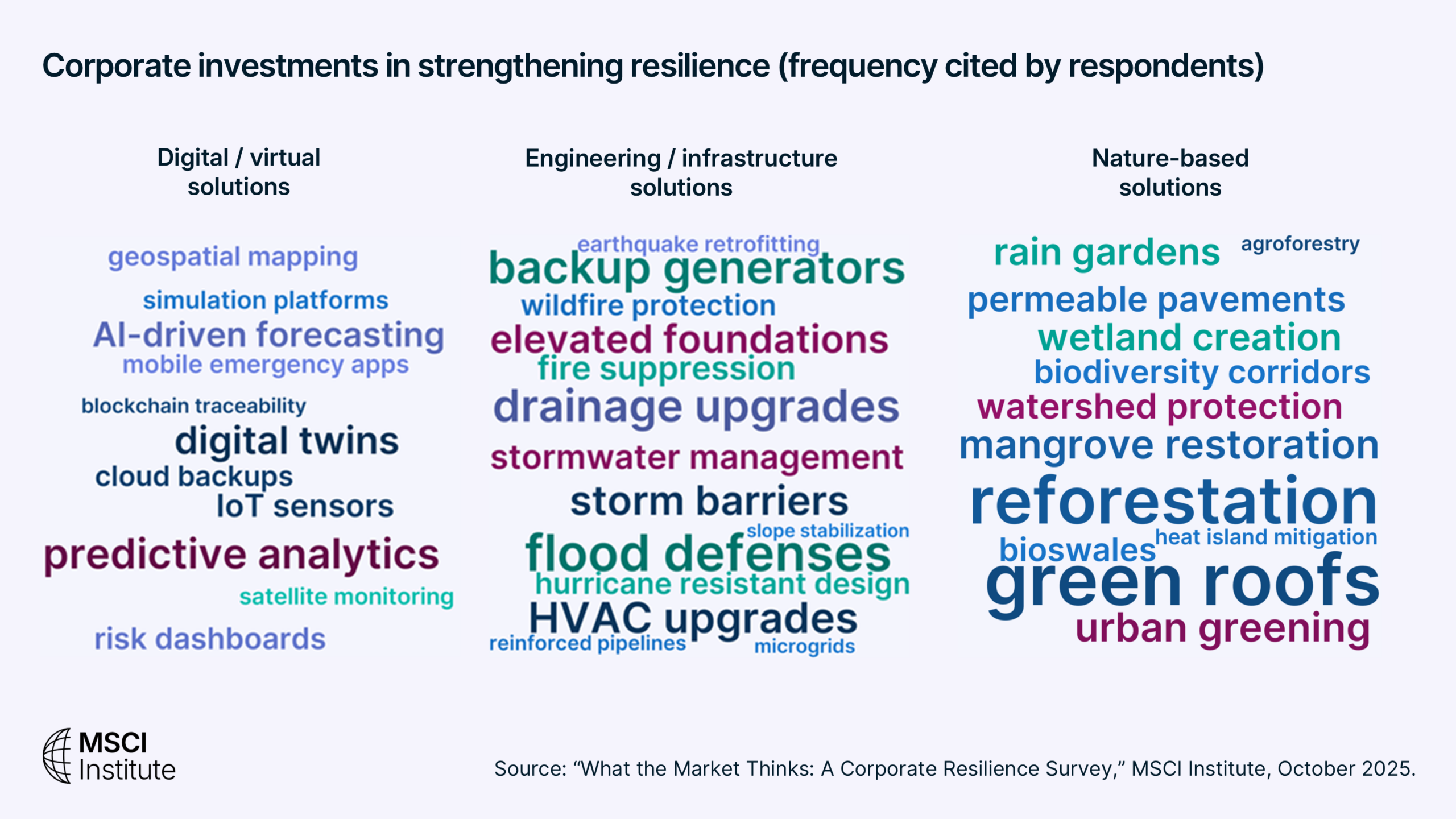
At the same time, business opportunities from servicing resilience are not yet a focus. Just 20% companies surveyed say they currently offer products or services that help their customers mitigate the impacts of extreme weather. Among those that do, resilience-enhancing products typically supplement existing product lines: Infrastructure and construction firms, for example, are embedding extreme-weather risk into project design and planning, while suppliers of building materials are experimenting with weather-resistant materials to meet rising demand.
Expecting a warmer (and costlier) future
Nearly all (99%) companies surveyed say that climate change poses a significant economic threat, with most already feeling its effects. Sixty-three percent report that climate-induced physical risks are currently having a significant impact on the global economy, while 36% expect such effects in the future. Similarly, in a 2024 MSCI Institute survey of global investors, 57% said physical risks are already affecting the global economy currently, while an additional 36% said they anticipate such impacts in the future.
Companies and investors surveyed also express parallel expectations for warming, with the largest share of companies (28%) and investors (34%) alike saying they expect average global temperatures to rise 2–3°C above preindustrial levels this century. Both align broadly with the views of climate scientists, more than three-quarters (77%) of whom say they expect a rise of at least 2.5°C, according to a Guardian newspaper survey in 2024.
The views expressed on these pages are the opinions of their respective author(s) only and do not necessarily reflect the views and opinions of UKSIF.
This website should not be taken as financial or investment advice or seen as an endorsement or recommendation of any particular company, investment or individual. While we have sought to ensure information on this site is correct, we do not accept liability for any errors.