Note: The views expressed on these pages are the opinions of their respective author(s) only and do not necessarily reflect the views and opinions of UKSIF.

This website should not be taken as financial or investment advice or seen as an endorsement or recommendation of any particular company, investment or individual. While we have sought to ensure information on this site is correct, we do not accept liability for any errors.
 

Why investors need to treat workforce mental health as a core stewardship issue

Amy Browne, Director of Stewardship and Deputy Head of Sustainability, CCLA

For CCLA, stewardship sits at the intersection of client priorities and long term value at risk. We believe that companies with strong sustainability and governance practices are best positioned to serve the interests of all stakeholders. Such companies demonstrate greater resilience to regulatory change, shifting consumer behaviour and long term challenges such as climate change.

Our stewardship team engages with companies across a wide spectrum of systemic and financially material issues, from climate resilience and labour standards to workplace culture and human rights. Increasingly, one issue cuts across all others: the mental health and wellbeing of the workforce.

For years, mental health was treated as a ‘soft’ topic, something for human resources departments to dip into at the margin. But the data tells a very different story. Poor mental health costs employers an estimated £1,800 per employee per year, and for a company the size of Amazon, that equates to an estimated £2.7 billion in lost productivity. Meanwhile, the return on investment for effective mental health interventions is estimated at £4.70 for every pound spent (Deloitte 2024). These are not marginal figures. They are financially material, strategically significant, and measurable.

Why we created the CCLA Corporate Mental Health Benchmark
When we launched the CCLA Corporate Mental Health Benchmark in 2022, our aim was simple: to bring transparency, accountability, and ambition to an area that had long lacked all three. We wanted to give investors a tool to assess how companies support their people, and to give companies a roadmap for improvement.

Since then, the benchmark has become a powerful catalyst for change. We have now published eight rankings over four years, conducting annual assessments and public league tables that shine a light on corporate performance. The investor community has rallied behind this work: our global investor coalition now represents $9.5 trillion in assets, signalling that mental health is firmly on the stewardship agenda.

The results speak for themselves. Seventy four companies have improved their ranking, including 13 that have moved up two tiers and three that have climbed three tiers. Collectively, these improved companies employ 5.3 million people worldwide. That is real world impact at scale.

What the latest benchmark tells us
The findings from 2025 reveal a tale of two markets. In the UK, we are seeing genuine momentum. Companies are increasingly embedding mental health into governance structures, reporting frameworks, and leadership priorities. The global cohort, by contrast, is more geographically diverse and heavily weighted toward the US, where progress is uneven.

There are standout improvers; companies that have made remarkable strides in transparency, leadership commitment, and workforce engagement. But there are also areas of concern. Several of the so called ‘magnificent seven’ companies that dominate global indices and shape the digital economy sit at the bottom of our ranking. They are extraordinary businesses, but our data suggests they are not yet extraordinary places to work.

The healthcare sector also presents a mixed picture. Novartis, Roche, Novo Nordisk, and Johnson & Johnson are working hard to improve, demonstrating that large, complex organisations can lead on mental health. Yet AstraZeneca has deteriorated more than any other company, falling 25 percentage points since its first assessment. As stewards, we respond accordingly. In AstraZeneca’s case, we escalated our concerns and voted against the CEO at its annual general meeting: a clear signal that in our view, mental health is not just a peripheral concern, but central to the company’s long-term resilience.

How companies can improve
For organisations seeking to strengthen their approach to workforce mental wellbeing, three practical steps stand out:
1. Leadership commitment
Senior leaders must set the tone. Mental health should be visible in strategy, governance, and reporting, and not confined to internal wellbeing campaigns.
2. Good working conditions
Workload, job design, autonomy, fair pay, and psychological safety matter. Companies must address the root causes of ill-health, not just offer support once people are struggling.
3. Measurement and management
Companies should track wellbeing, respond to findings, and build resilience through training, listening, and continuous learning.

Why the benchmark works
The success of the benchmark reflects several factors: the financial case for action, the credibility of the methodology, its alignment with WHO and ILO standards, peer competition, strong investor collaboration, and sustained media attention. Together, these elements create a powerful incentive for companies to improve.

That said, every company is different. One wanted to be recognised as a global business that genuinely cares about its employees. Another was responding to tragic employee suicides. A third recognised that our advice was sound and saw no reason not to act. A fourth was tackling negative media coverage. All of them understand the same truth: supporting mental health boosts productivity, reduces turnover and sickness absence, and strengthens their appeal to current and future employees.

As investors, we cannot afford to ignore the wellbeing of the people who create corporate value. Mental health is not a ‘nice to have’, but a strategic imperative. Through stewardship, transparency, and collaboration, we can help to ensure that companies treat it that way.

The views expressed on these pages are the opinions of their respective author(s) only and do not necessarily reflect the views and opinions of UKSIF.

This website should not be taken as financial or investment advice or seen as an endorsement or recommendation of any particular company, investment or individual. While we have sought to ensure information on this site is correct, we do not accept liability for any errors.
Note: The views expressed on these pages are the opinions of their respective author(s) only and do not necessarily reflect the views and opinions of UKSIF.

This website should not be taken as financial or investment advice or seen as an endorsement or recommendation of any particular company, investment or individual. While we have sought to ensure information on this site is correct, we do not accept liability for any errors.


Sustainability storytelling: A short guide to writing an annual ESG report

Roger Lewis, UKSIF Membership Committee Member

The Millennium, ‘Y2K’, gave us a Dome, a Bridge, a Bug for 11:59:59pm on December 31st, 1999 and ten Development Goals. These Goals aimed to help the future planet and future people meet their needs without compromising our own, the classic definition of sustainability. Twenty five years ago, a bit of reporting and donations to charities made up the bulk of ‘corporate social responsibility’ and efforts to meet these Goals, since rebranded the 17 UN Sustainable Development Goals. Such CSR came when companies had cash left over after paying dividends and interest, or after financing growth and expansion strategies.

But reporting alone is not a substitute for meaningful action. And while well intentioned, there are pitfalls with sustainability reporting. One risk is that focus on disclosure distracts from tangible sustainability outcomes. Another is too much inconsistent or incomplete data, leading to greenwashing. It is a complex topic that we are trying to summarise progress in. So before even picking up a pen, a sustainability report should understand four basic factors.

In the past year, what were the greatest material issues and impacts that you faced? Ninety plus factors make up ‘ESG’. Data providers and active investors can say what these risks, opportunities and exposures are for a company, and how well they are being managed.

Keeping the audience in mind is a good principle. Who are your stakeholders, what is their influence and interest in sustainability, and how can they help? Ideally the readers are critical to achieving sustainability goals, whether it is revenue from green products or environmental and societal upsides.

Next, what challenges did you face? Potentially shifting priorities with the digitisation and AIfication of everything. Or policymakers sending mixed signals. Take a large cap European company with over 50,000 staff but less than EUR50m revenue. Before it had to report detailed sustainability metrics, but now we’re not sure after the so-called EU Omnibus regulation. Or challenges from disruption to operations (read: suppliers in areas prone to wildfires, like California).

Last, what actions did you take? Getting a fund labelled for sustainability is real and material example, and means joining 7,500 funds and $3tr, globally and not just among EU SFDR peers. Another is engaging a portfolio company to recognise transition and physical climate risks, or screening suppliers for ESG risk in procurement – solar panels from forced labour for anyone? – as an area under a company’s direct control.

Now we can begin to type and create something compelling. Start by looking inwards and core environmental, nonfinancial metrics. Carbon is a must, up to scope 3 if you don’t want to be accused of ‘transition-washing’ and overstating your initiatives for climate. Water, waste and biodiversity footprints can also feature if material to a sector. Engaging colleagues and communities, and standard corporate governance declarations for risk, shareholders and boards complete this section.

And then look outwards. For investors, this means how many tonnes of CO2 their debt and equity financed, and how they engaged their portfolio companies to achieve positive outcomes. For companies, it’s environmental and social efforts, and processes and policies in place to implement. For both, frameworks for standardisation and validation help to avoid overwhelming stakeholders with data while providing little actionable insight. So we have TCFD, TNFD, CDP, ISSB and GRI as the top picks to consider.

Doing all this should leave your audience, human or AI, thinking that your organisation has just communicated a credible and robust strategy for sustainability. One which is suitable for a quarter of a century and much planetary and societal upheaval since the Millennium.

The views expressed on these pages are the opinions of their respective author(s) only and do not necessarily reflect the views and opinions of UKSIF.

This website should not be taken as financial or investment advice or seen as an endorsement or recommendation of any particular company, investment or individual. While we have sought to ensure information on this site is correct, we do not accept liability for any errors.

Note: The views expressed on these pages are the opinions of their respective author(s) only and do not necessarily reflect the views and opinions of UKSIF.

This website should not be taken as financial or investment advice or seen as an endorsement or recommendation of any particular company, investment or individual. While we have sought to ensure information on this site is correct, we do not accept liability for any errors.


Actionable Insights: Top Sustainability Themes in 2026

Mirtha Kastrapeli, Global Head – ISS STOXX Research Institute, ISS STOXX

The year 2025 was marked by an unprecedented rise in global economic policy uncertainty and some regulatory headwinds for sustainable investment. The new year is set to be one of pragmatism, as investors continue to expand and refine their analysis of their portfolio companies’ business case for sustainability.

The ISS STOXX annual global outlook report, Actionable Insights: Top Sustainability Themes in 2026, highlights this pragmatism. In this report, we focus on the climate change preparedness of public companies, physical risk analysis using geospatial asset level data, AI governance, regulatory developments around labor rights, and data about investment flows into sustainable funds.

On climate preparedness, we propose a deeper analysis of companies’ ability to assess and manage climate risk that goes beyond traditional emissions data and targets, which tell only half the story. By examining governance, disclosure, and implementation indicators (such as management’s role in climate assessments, climate risk reporting in financial accounts, and capital allocation), investors can better assess the credibility of companies’ climate preparedness.

This highlights that while 74% of the companies assessed overshoot their 2030 carbon budgets, only 42% are considered “unprepared.” Being unprepared means that these companies not only overshoot their stated carbon budgets but also exhibit weak organizational readiness. For portfolio construction, the emissions-only approach potentially excludes all companies that overshoot their budgets, regardless of their organizational capacity. That removes from consideration “transition leaders”: companies that overshoot their budgets yet have strong governance structures.

Our analysis also shows that 17% of companies are considered “Best Positioned”: they simultaneously both meet their carbon budgets and demonstrate strong governance and operational readiness. These companies are best prepared as transition pressure intensifies and organizational infrastructure becomes more visible.

We also examined physical climate and nature risk across different scenarios and time horizons. Specifically water stress and heat wave risk in data centers using geospatial data. Based on granular data covering 100 assets globally, heat stress is expected to intensify: 43 data centers face medium or high risk in the next 15 years, rising to 64 over 30 years. Heatwaves increase cooling demands and lead to higher outage risks, operational costs, and need for infrastructure upgrades.

Another area of focus is Artificial Intelligence (AI). AI will likely continue to drive global markets’ momentum, yet investors’ questions around AI governance are also likely to intensify. Our research introduces the concept of Ethical AI, which reflects broad values and principles—such as data protection and transparency—aimed at enhancing AI’s benefits while reducing risks. Other crucial concepts are Responsible AI, which defines how Ethical AI principles are operationalized; and Just AI, which focuses on AI’s societal and economic impacts, ensuring fair and balanced outcomes for all stakeholders. Analysis of corporate disclosures from leading technology companies—the “Magnificent 7”—shows that most articulate Ethical AI values, but fewer translate them into Responsible AI governance frameworks or address the human implications central to a Just AI transition.

On the social side, we have analyzed regulatory developments in labor rights. Multinational companies, which are often part of extensive value chains, must navigate a range of labor regulations directly applicable to their operations while conducting effective due diligence over suppliers. This process may grow more complicated, as labor regulation in several jurisdictions is moving toward more stringent due diligence requirements. Data from ISS STOXX Corporate Ratings show significant or notable room for improvement across all labor-related disclosures under the Supplier Social Standard. Low levels of disclosure expose these companies to reputational, legal, and financial risks.

Finally, we reviewed the resilience of sustainable investment during 2025, notwithstanding lingering regulatory headwinds. This relative strength is evident in sustainable ETF flows globally, which have continued to grow at a rate comparable to the overall ETF market. Based on ISS MI MarketPulse data, Sustainable ETF AUM as of September stood at $631 billion, up 18% since December 2024. Further, while results differ across index methodologies, sustainability indices have often shown resilience and sometimes outperformance, particularly in European indices.

2026 is set to be a year of pragmatism in the sustainable investment space. More granular data, more rigorous models, and deeper industry-specific insights can help investors better assess the business case for sustainability.

The views expressed on these pages are the opinions of their respective author(s) only and do not necessarily reflect the views and opinions of UKSIF.

This website should not be taken as financial or investment advice or seen as an endorsement or recommendation of any particular company, investment or individual. While we have sought to ensure information on this site is correct, we do not accept liability for any errors.

Note: The views expressed on these pages are the opinions of their respective author(s) only and do not necessarily reflect the views and opinions of UKSIF.

This website should not be taken as financial or investment advice or seen as an endorsement or recommendation of any particular company, investment or individual. While we have sought to ensure information on this site is correct, we do not accept liability for any errors.


ESG outlook: How are responsible investing trends converging with broader economic realities?

Michelle Dunstan, Chief Responsibility Officer, Janus Henderson Investors

Responsible investing is shifting from aspirational ESG ideals to financially material considerations, aligning with broader economic realities. Chief Responsibility Officer Michelle Dunstan’s 2026 outlook highlights the evolving definitions of “responsible” investments, and why companies need to adapt to “conscious consumer” demands.

The shift from moral imperatives to financial materiality marks a move from aspirational ideals to practical ESG integration. In 2026, responsible investing will balance short- and long-term outcomes, balancing financial priorities with social and environmental goals. We see three macro drivers shaping markets: geopolitical realignment, demographic shifts, and higher capital costs—signalling convergence between ESG trends and economic realities.

The impact of geopolitics: Rethinking what is “responsible”
Headline events in 2025 have driven renewed focus on certain sectors. Military escalation and increased defence spending – especially in Europe – have prompted a re-examination of historical aversions to this sector. Similarly, energy security concerns and increased demand driven by the acceleration of AI and datacentres have led to renewed interest in nuclear energy and natural gas. Tariffs have sharpened the focus on efficiency, competitiveness, and national security.

Many asset managers have responded by rescinding broad exclusions in defence and energy, causing some consternation among clients and asset owners. This raises a philosophical question: If what’s considered “responsible” can change so dramatically, where does that leave ESG-focused portfolios?

Financial materiality aligns with sustainable growth
In this context, asset managers are adopting thoughtful analysis and engagement to ensure adherence to humanitarian standards and effective risk management – indeed, companies in these sectors can contribute to social and economic resilience for sustainable growth. This is particularly true in defence, which historically has faced issues of bribery, corruption and human rights abuses, and energy, which presents its own set of ESG risks. Defence companies continue to face corruption and human rights concerns, while energy companies grapple with obvious environmental challenges.

A more case by case approach is emerging—one that emphasises direct engagement, scrutiny of practices, and a sober assessment of long term risks. The argument is less about moral positioning and more about recognising how geopolitical instability and energy dynamics affect financial resilience.

The impact of demographic and lifestyle shifts: health and wealth disrupt consumer preferences
Demographic and lifestyle changes are profoundly reshaping the healthcare and consumer sectors. Generational shifts, reinforced by regulation, technology and social media, are driving new behaviours around food, diet, and health management. The rapid adoption of weight loss drugs and heightened awareness of ultra-processed foods are redefining the fight against obesity. Governments are responding with legislation to address the economic strain of chronic diseases.

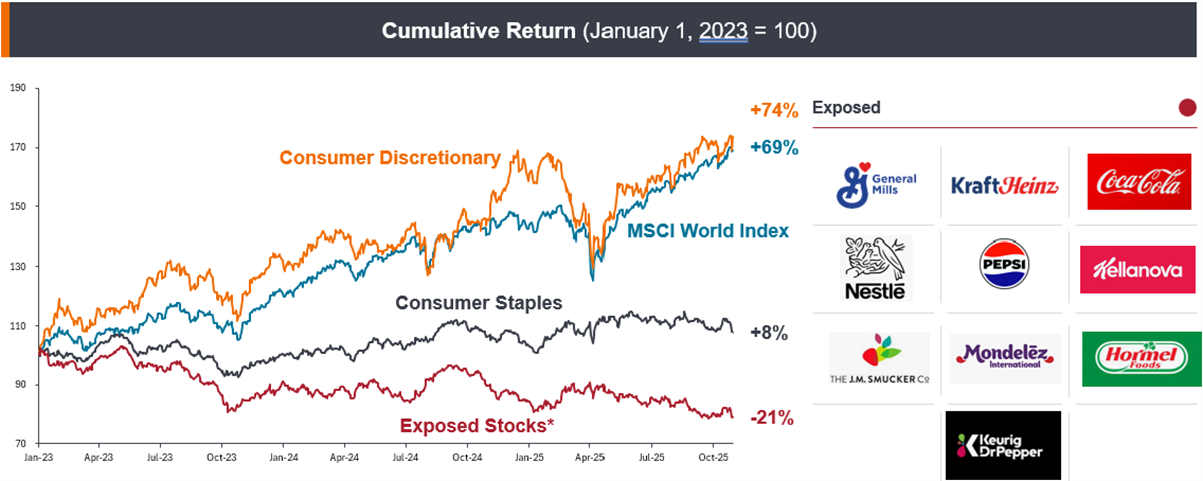
Technology has elevated access to information, and the social media visibility of “ideal” lifestyles is influencing both aspirations and actions. Consumers are increasingly seeking healthier, cleaner, and more sustainable choices, upending historical patterns in food & beverage, and wellness. Forward-thinking companies are adapting to meet the demands of the “conscious consumer,” creating winners and losers in the marketplace. This has typically led to significant underperformance for companies most exposed to the downside of these trends (image below). Asset managers are analysing these trends and engaging with companies to understand the long-term impacts.

The impact of costs: Pivot to real action in regulation, climate, and biodiversity
Geopolitics, tariffs, and the higher cost of capital have renewed focus on competitiveness and resilience, prompting a more practical approach to ESG. Ignoring these factors risks mispricing securities, so climate and biodiversity are now assessed for their measurable impact on financial performance. Investors are taking a more systematic approach to evaluating companies’ transition plans, exposure to regulatory change, and vulnerability to stranded assets.

The focus is less on whether companies make broad climate commitments and more on whether those commitments translate into credible actions that materially affect risk and return. Sustainability is no longer treated as a parallel layer of analysis but as a factor embedded directly in cash flow modelling and valuations.

A more grounded era for ESG
Rather than treating ESG as a separate framework, integration will continue to be critical amid disruptive megatrends like climate change and AI, which pose significant risks and opportunities for investors. As we look ahead through 2026, responsible investing trends are converging with broader economic realities. Instead of relying on sweeping principles or exclusion lists, investors are being pushed toward deeper analysis, more active engagement, and an acceptance that the definition of “responsible” will continue to evolve—often in response to forces outside the industry’s control.

You can read more on the Janus Henderson website here.

The views expressed on these pages are the opinions of their respective author(s) only and do not necessarily reflect the views and opinions of UKSIF.

This website should not be taken as financial or investment advice or seen as an endorsement or recommendation of any particular company, investment or individual. While we have sought to ensure information on this site is correct, we do not accept liability for any errors.

Note: The views expressed on these pages are the opinions of their respective author(s) only and do not necessarily reflect the views and opinions of UKSIF.

This website should not be taken as financial or investment advice or seen as an endorsement or recommendation of any particular company, investment or individual. While we have sought to ensure information on this site is correct, we do not accept liability for any errors.


Companies are confronting the rise in physical risk head-on

Umar Ashfaq, Research Director, MSCI Institute

Companies are approaching the costs of extreme weather and other hazards of a warming world with their eyes wide open.

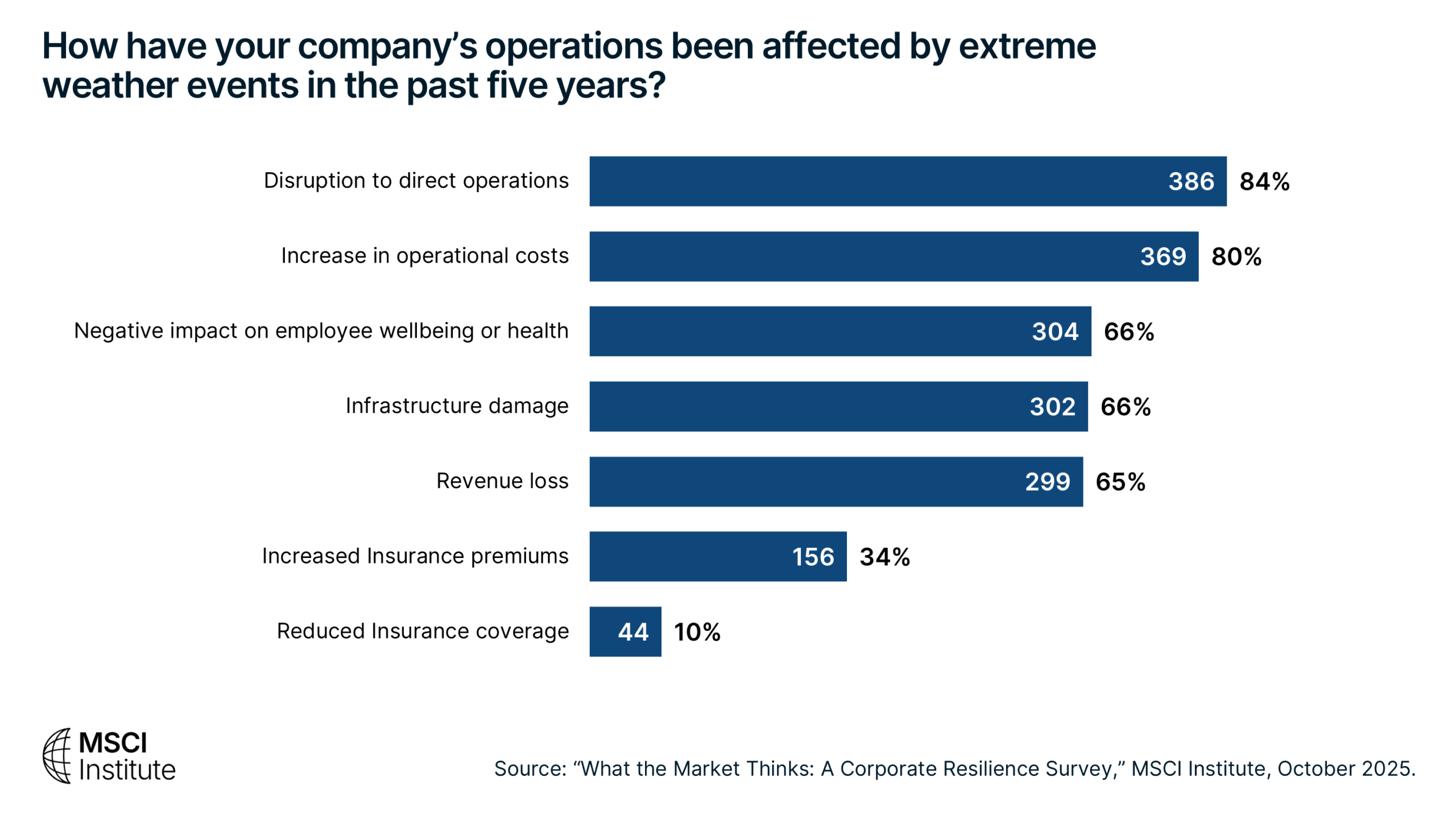
That’s among findings that come through a survey by our Institute that captures the views of risk, operations and finance officers at 550 listed and unlisted companies in 15 countries in the most physical-risk exposed industries. Among the findings:

    • More than 80% of companies surveyed say their operations and supply chains have been directly disrupted by extreme weather events such as severe storms, dangerous heat or flooding in the past five years.
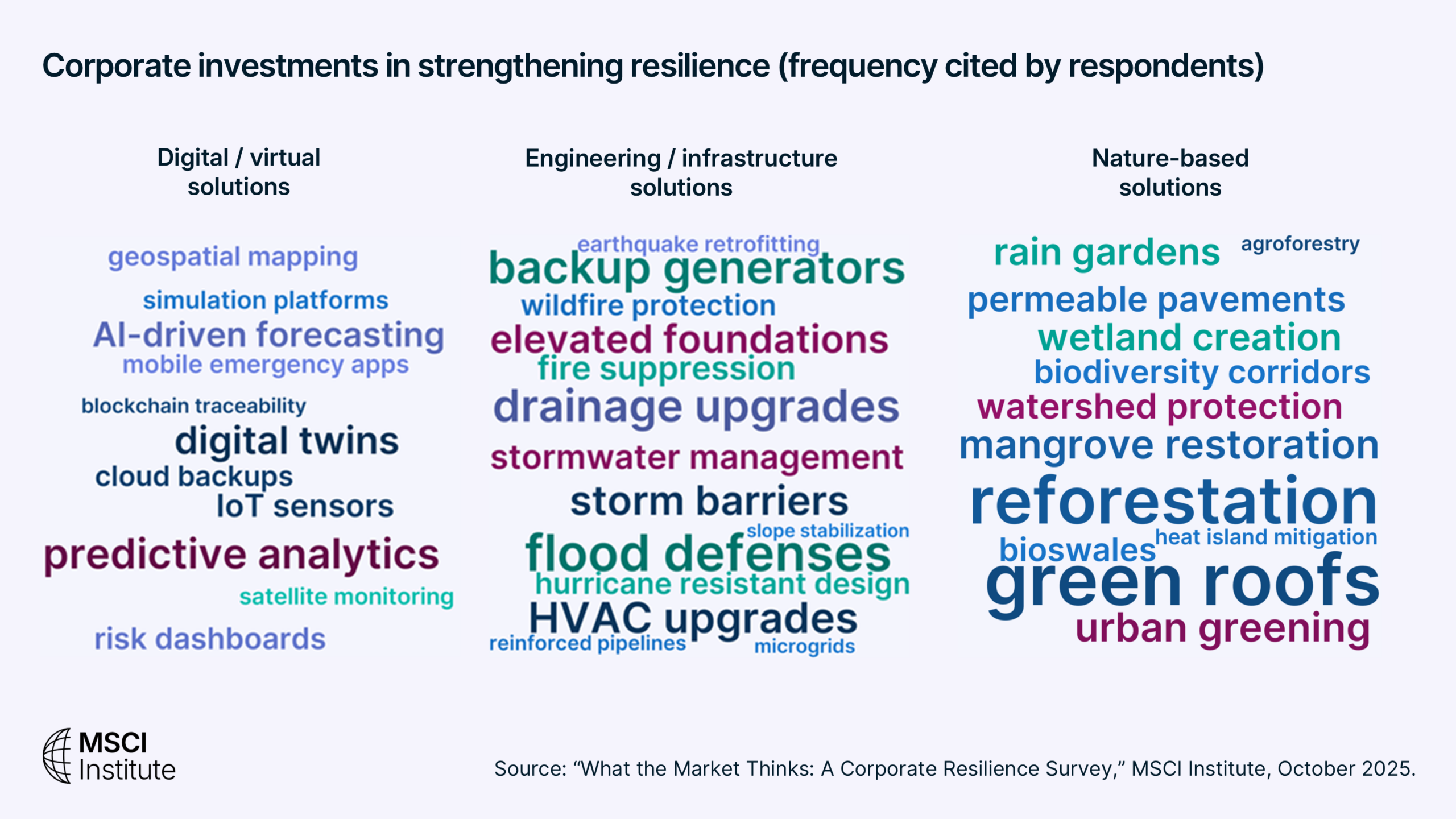
    • Companies that have been recently impacted by extreme weather events (32%) are twice as likely as companies not impacted (14%) to have completed infrastructure upgrades, highlighting how direct experience accelerates action.
    • Nearly all (94%) of companies surveyed say they assess the risks of extreme weather, with severe storms (87%), flooding (78%), natural disasters (76%) and extreme heat (67%) topping the list of hazards assessed. Most companies (85%) estimate potential losses from extreme weather events.

Conducted in September and October by the MSCI Institute, the survey examines how companies assess and manage risks from extreme weather events, and is augmented by interviews with company executives and MSCI’s physical risk analysis.

“In the last five years, we have seen a downturn in production in hurricane-exposed regions,” an operations manager with a large, listed health care company in Germany told us. “You can’t move a plant out, so you prepare as best you can and learn from every event.”

The survey arrives as extreme weather events and other physical risks intensify, with average warming since 2023 on track to exceed 1.5°C. In the final three months of 2025 alone, storms worsened by warming cost lives and livelihoods across Southeast Asia, Morocco, the Caribbean (where physical damage in Jamaica alone totaled USD 8.8 billion, about 41% of that country’s GDP) and the U.S. state of Washington.

Hurricanes and other severe storms drove an estimated USD 50 billion in global insured losses (the third-costliest year on record) last year, continuing a multiyear upward trajectory of losses from such storms and highlighting the growing challenge for companies, investors, lenders and insurers of measuring and managing physical risk.

Physical risk management becoming formalized
Companies are increasingly folding physical risk into their overall governance, our survey finds. Three-quarters of companies (76%) surveyed report having a framework for monitoring and managing risks from extreme weather, with adoption highest among companies recently impacted by such events (81%). (To help investors address physical climate risk in practice, our report maps our survey to the Physical Climate Risk Appraisal Methodology developed by the Institutional Investors Group on Climate Change.)

Resilience is becoming part of executive compensation too. A majority of companies (61%) that we surveyed link director and executive pay to physical risk management. Nearly one-fifth (19%) tie resilience to the pay of senior management. Oversight of physical risk is increasingly shared between boards and executives, highlighting that companies view resilience as a strategic priority and a core element of corporate governance and leadership.

A return on resilience investments
Investments in adaptation and resilience pay, our survey suggests. Eighty-two percent of companies surveyed say that investing in operational resilience have delivered positive financial or reputational outcomes, with more than two-thirds citing increased investor interest and more favorable terms for insurance. Companies also report that resilience measures have improved lending conditions, adding to evidence that investment in climate adaptation and resilience strengthens financial stability and investor confidence.

At the same time, business opportunities from servicing resilience are not yet a focus. Just 20% companies surveyed say they currently offer products or services that help their customers mitigate the impacts of extreme weather. Among those that do, resilience-enhancing products typically supplement existing product lines: Infrastructure and construction firms, for example, are embedding extreme-weather risk into project design and planning, while suppliers of building materials are experimenting with weather-resistant materials to meet rising demand.

Expecting a warmer (and costlier) future
Nearly all (99%) companies surveyed say that climate change poses a significant economic threat, with most already feeling its effects. Sixty-three percent report that climate-induced physical risks are currently having a significant impact on the global economy, while 36% expect such effects in the future. Similarly, in a 2024 MSCI Institute survey of global investors, 57% said physical risks are already affecting the global economy currently, while an additional 36% said they anticipate such impacts in the future.

Companies and investors surveyed also express parallel expectations for warming, with the largest share of companies (28%) and investors (34%) alike saying they expect average global temperatures to rise 2–3°C above preindustrial levels this century. Both align broadly with the views of climate scientists, more than three-quarters (77%) of whom say they expect a rise of at least 2.5°C, according to a Guardian newspaper survey in 2024.

The views expressed on these pages are the opinions of their respective author(s) only and do not necessarily reflect the views and opinions of UKSIF.

This website should not be taken as financial or investment advice or seen as an endorsement or recommendation of any particular company, investment or individual. While we have sought to ensure information on this site is correct, we do not accept liability for any errors.

Note: The views expressed on these pages are the opinions of their respective author(s) only and do not necessarily reflect the views and opinions of UKSIF.

This website should not be taken as financial or investment advice or seen as an endorsement or recommendation of any particular company, investment or individual. While we have sought to ensure information on this site is correct, we do not accept liability for any errors.


3 Myths that Hold Back Sustainable Investing

Sam Adams, CEO & Co-founder, Vert Asset Management

When financial advisors think about sustainable investing, many picture complex frameworks or client conversations filled with hard questions. However, sustainable real estate investing can be simple, practical, and aligned with financial goals. Yet, misconceptions often hold advisors back from exploring this space.

At Vert, we’ve found that addressing these misunderstandings not only builds confidence for advisors but also helps them guide clients toward resilient, future-focused portfolios. Let’s look at three of the most common misconceptions.

Misconception 1: Sustainable buildings cost more and hurt returns
A frequent assumption is that “green” means “expensive,” both to build and to own. But research and real-world examples tell a different story.

  • • Lower operating costs: Energy-efficient upgrades often cut utility bills significantly. The Empire State Building retrofit reduced energy use by 38% and achieved a payback in just three years.
  • • Stable cash flows: Tenants increasingly prefer buildings with sustainability features, leading to higher occupancy rates and reduced turnover.
  • • Stronger risk management: Green-certified buildings may help to reduce exposure to rising energy prices and other long-term risks.

For advisors, this means sustainable real estate isn’t about sacrificing returns for values—it’s about aligning financial performance with long-term stability.

Misconception 2: Sustainability in real estate is only about the “E”
While environmental factors like energy use and emissions are crucial, the “S” (social) and “G” (governance) dimensions matter just as much for investment outcomes.

  • • Social factors: Walkability, transit access, and indoor air quality all influence tenant satisfaction and demand. Affordable housing or inclusive hiring policies can strengthen community resilience and reduce reputational risk.
  • • Governance factors: Strong governance practices such as transparent reporting, clear sustainability goals, and engaged boards signal management quality, which investors increasingly value.

When talking to clients, advisors can highlight that sustainable real estate investing takes a holistic view, considering not just energy efficiency but also tenant well-being, community impact, and long-term governance.

Misconception 3: Real estate investors can’t move the needle on sustainability
Because real estate is fragmented across markets and property types, some assume change is impossible. But listed real estate investment trusts (REITs) own roughly 10% of U.S. commercial real estate, and they can scale improvements quickly.

  • • Portfolio-wide impact: When a REIT finds an upgrade that adds value, they often roll it out across many buildings in their portfolio.
  • • Efficiency incentives: Operational efficiencies that reduce expenses may contribute to larger dividend distributions.
  • • Market leadership: Investors allocating to REITs that lead in sustainability are supporting companies setting new standards for resilience and competitiveness.

This isn’t niche stewardship, it’s mainstream, risk-adjusted portfolio construction.

Turning misconceptions into confident conversations

Oftentimes, the challenge for advisors isn’t a lack of interest; it’s uncertainty. By reframing misconceptions into clear talking points, you can help clients see sustainable real estate not as a compromise, but as a practical, profitable, and future-ready investment option.
At Vert, our goal is to make these conversations easier. We provide advisors with tools, resources, and investment solutions that bridge sustainability and real estate in a way that’s grounded in research and simple to explain.

Want to dig deeper? Our paper, Investing for Sustainability: Real Estate, explores the evidence behind sustainable real estate investing in more detail.


Note: Vert Asset Management is a sustainable real estate investment manager dedicated to helping financial advisors build resilient, future-ready portfolios. We connect institutional-quality investments with the long-term goals of clients, focusing on both financial returns and sustainability.

Investors should consult their investment professional prior to making an investment decision.

The views expressed on these pages are the opinions of their respective author(s) only and do not necessarily reflect the views and opinions of UKSIF.

This website should not be taken as financial or investment advice or seen as an endorsement or recommendation of any particular company, investment or individual. While we have sought to ensure information on this site is correct, we do not accept liability for any errors.

Note: The views expressed on these pages are the opinions of their respective author(s) only and do not necessarily reflect the views and opinions of UKSIF.

This website should not be taken as financial or investment advice or seen as an endorsement or recommendation of any particular company, investment or individual. While we have sought to ensure information on this site is correct, we do not accept liability for any errors.


The Local Investing Mandate: Why the LGPS Local Investing Agenda is a Strategic Imperative for UK Sustainable Finance

Sarah Forster, CEO and Co-founder, The Good Economy

A significant policy evolution is underway within the United Kingdom’s investment landscape – one that promises to reshape the relationship between institutional capital and local economic development. The government’s ‘Fit for the Future’ pension reform programme has established a powerful new mandate for the Local Government Pension Scheme (LGPS). This is not a minor regulatory adjustment, but a structural realignment of one of the world’s largest pension schemes – with nearly £400 billion in assets, projected to reach £1 trillion by 2040 – to address some of the UK’s most persistent economic challenges, including regional inequalities and a chronic domestic investment gap.

For the sustainable finance community, this development moves place-based impact investing from a niche, discretionary activity to a core strategic consideration. At The Good Economy, we have prepared an essential strategic guide for this new terrain with our latest White Paper, “Scaling-Up Local Investing for Place-Based Impact“. Based on extensive consultation with the LGPS sector, we have created a framework for navigating what is arguably the most important domestic impact investing agenda of the decade.

A Shift from Discretionary to Mandatory Action

The ‘Fit for the Future’ reforms represent more than a recommendation; they establish a formal requirement for LGPS Administering Authorities (AAs) to develop explicit local investing strategies. Crucially, this includes setting target allocation ranges and reporting annually on the impact of those investments. As a result, transparency of impact and local benefit is going to be increasingly important for LGPS fund allocators.

This mandate necessitates a clear and consistent framework for identifying and categorising suitable investments. We propose a practical methodology built on the Place-Based Impact Investing (PBII) model. This organises opportunities into six core pillars that are both investable and central to local development: Housing, Regeneration / Real Estate, Infrastructure, Clean Energy, SME Finance and Natural Capital. These pillars provide a common language for investors and local government, defining the tangible, real-economy assets capable of delivering both appropriate risk-adjusted returns for pension members and measurable, positive outcomes for communities.


A New Alignment: Integrating Capital with Place-Based Strategy

The strategic innovation of this agenda lies in its mechanism for alignment. The framework requires LGPS funds and their Pools to collaborate directly with devolved Strategic Authorities (SAs), ensuring that investment strategies are informed by new, bottom-up Local Growth Plans (LGPs).

This creates a systematic pathway connecting top-down institutional capital with democratically defined, place-specific priorities. It ensures that capital allocation is not arbitrary but is instead grounded in a coherent economic strategy. For example, a pension fund can now be expected to consider investments in a local SME finance fund or a clean energy project that has been identified as a priority within that region’s own growth plan, all while fulfilling its fiduciary duty.


The Market Response: An Emerging Need for Specialised Products

This new framework necessitates a sophisticated market response. The operating model outlined by the government requires the AAs and Pools to collaborate on strategy, while Pools will be responsible for implementation and execution. Consequently, these Pools will require a new generation of specialised investment products.
The demand will be for:

• Specialist fund managers with demonstrable regional expertise
• Innovative investment structures, such as regional ‘sleeves’ on national funds
• Blended finance vehicles that can effectively combine public and private capital
• Co-investment opportunities in infrastructure, housing, and regeneration

And, importantly, fund managers will need to understand their local impact and identify the extent to which these products are aligned with local growth plans.

Pioneering examples of these models are already in operation, demonstrating the viability of the approach. For the UK’s sustainable finance sector, this represents a substantial opportunity to design and deliver the institutional-grade products that will be essential for the successful implementation of this agenda.

You can view the case studies here.


The Measurement Challenge: Standardising Place-Based Impact Reporting

A pivotal element of the new mandate is the requirement for impact reporting. The government has, at this stage, refrained from prescribing specific metrics, creating a crucial opportunity for the industry to lead in establishing a robust and credible standard.

This is a challenge the sustainable finance community is uniquely positioned to address. Our White Paper proposes a practical methodology grounded in the internationally recognised Five Dimensions of Impact (what, who, how much, contribution, risk). This approach enables a move beyond generic ESG scoring towards a more nuanced framework for measuring place-based outcomes in private markets. Building on the PBII Reporting Framework, co-created with a number of LGPS and asset managers, it will allow us to demonstrate, with credible data, how LGPS capital contributes to sustainable economic growth through job creation, the development of affordable homes, and progress towards decarbonisation within the communities where scheme members live and work.


Conclusion

The ‘Fit for the Future’ agenda represents a landmark development for UK domestic investment. It establishes a market for institutional-grade products that can deliver both financial and social returns and provides the mechanism to align substantial capital flows with local, sustainable development strategies. This is the moment for the sustainable finance sector to provide the expertise and innovation required to help turn policy into lasting prosperity for communities across the UK.


Note: The views expressed on these pages are the opinions of their respective author(s) only and do not necessarily reflect the views and opinions of UKSIF.

This website should not be taken as financial or investment advice or seen as an endorsement or recommendation of any particular company, investment or individual. While we have sought to ensure information on this site is correct, we do not accept liability for any errors.

Note: The views expressed on these pages are the opinions of their respective author(s) only and do not necessarily reflect the views and opinions of UKSIF.

This website should not be taken as financial or investment advice or seen as an endorsement or recommendation of any particular company, investment or individual. While we have sought to ensure information on this site is correct, we do not accept liability for any errors.

Climate Progress of just another COP out?

Miranda Beacham, Head of UK Responsible Investment, Aegon Asset Management

COP 30 is upon us – being held this week in Belem, Brazil. This is the 10th anniversary of the Paris Agreement and a good time to look back on what has been achieved over the last decade and what needs to come next.

In Paris, back in 2015, there was an admission that swift action was needed to prevent a climate catastrophe. A bold agreement was reached to keep the global temperature to well below 2° above pre-industrial levels and to limit the increase to 1.5° by means of emission reduction targets (known as Nationally Determined Contributions – NDCs), set by individual countries. These commitments included measures for adapting to climate change and providing financial support to developing nations most affected by its impact. Crucially, the agreement required all parties to progressively enhance their emission reduction efforts over time.

When the agreement came into force in November 2016, it was surrounded by positivity with 55 countries ratifying the agreement, accounting for 55% of the global emissions.

What has been achieved since?

The 1.5° goal has become a north star for all climate commitments and therefore those who monitor this data regularly were dismayed to read the Copernicus report in January this year showing that the global temperature rise in 2024 had breached the 1.5° limit. However, scientific convention means that this goal is based a long-term average – i.e. 20 years – with the first “breach year” being the midway point. As a result, it will be a further nine years before the breach can be declared officially.

Global Surface Air Temperature Increase

Source: Copernicus Climate Change Service (C3S) / European Commission by the European Centre for Medium-Range Weather Forecasts (ECMWF).

Given the trend in global temperature, highlighted in the chart above, it does not look like meaningful progress has been made since 2015. It is clear the NDCs are intended to be the implement for driving change – but do they stack up against the 1.5° target?

One of the biggest issues with the NDCs is that President Trump withdrew the US from the Paris Agreement. Latest figures from the EU show that the US is responsible for 11% of global emissions in 2024, so its loss from this process is significant. It could also have knock on effects to the overall ambition of other countries, who may feel it is pointless if the US is not willing to engage in a meaningful way. However, we see China committing to a target, based on absolute volumes of emissions, which is progress, albeit they have not submitted a NDC yet. China accounts for around 30% of global emissions and the targets set fall short of net zero.

In the rest of the world, 65 countries have submitted their 2035 NDCs – which sounds promising until it becomes apparent that there are varying degrees of alignment and 128 countries have failed to submit, with the COP summit only days away.

The reality is that 65% of global emissions are covered by NDCs until June according to the Climate Action Tracker. The question is whether this is enough or if there is a better way to motivate change?

Brazil, the host nation, is keen to take the lead. It has suggested a Globally Determined Contribution – a broader, more inclusive framework that engages cities, indigenous peoples, youth and businesses alongside national governments in determining how climate change can be tackled.

It is also suggesting a Global Ethical Stocktake – with the plan to include dialogues with civil society across all continents. These reflect on the values, behaviours and responsibilities that must shift for UN climate commitments to become a reality and ensure historically excluded voices are not ignored in the negotiations.

Finally, it aims to introduce the Tropical Forest Forever Facility – a fund aimed at mobilising $4 billion annually to reward countries for conserving tropical forests.

These are lofty ambitions, only time will tell if they are successful in achieving them.

Are there any reasons to be cheerful?

There are a few things that have happened in the last 10 years that, in all probability, would not have happened without a global focus on emission reduction.

In 2015 solar and wind energy made up less than 5% of the energy mix – they now represent 15%. Sales of electric vehicles have grown from 540,000 in 2015 to 15.1 million in 2025, fuelled by new battery and charger technology and we are also seeing most developed countries successfully decoupling emissions from economic growth.

What can we expect from COP 30?

The thematic days suggest a broader scope of progress. The opening days will focus on cities, infrastructure and resilience – signalling that the discussion is moving on from mitigation and recognising that we need to adapt to the changing environment.

The debates will move on to discussions around moral obligation and governance of change before heading on to biodiversity. For too long biodiversity and climate change have been discussed as different topics whereas, in reality, they are two sides of the same coin.

As COP30 unfolds in the heart of the Brazilian rainforest, we’ll be watching closely. In future articles, we’ll explore how these ambitions translate into action – and what they mean for investors.

Note: The views expressed on these pages are the opinions of their respective author(s) only and do not necessarily reflect the views and opinions of UKSIF.

This website should not be taken as financial or investment advice or seen as an endorsement or recommendation of any particular company, investment or individual. While we have sought to ensure information on this site is correct, we do not accept liability for any errors.

Note: The views expressed on these pages are the opinions of their respective author(s) only and do not necessarily reflect the views and opinions of UKSIF.

This website should not be taken as financial or investment advice or seen as an endorsement or recommendation of any particular company, investment or individual. While we have sought to ensure information on this site is correct, we do not accept liability for any errors.

When will alternative fuels take off?

Will Farrell, Manager – Engagement and Michael Yamoah, Director – Engagement, Federated Hermes

Biofuels, hydrogen, and sustainable aviation fuel have been mooted as potential low-carbon alternatives to fossil fuels. However, although they increasingly feature in company transition plans and government policies as an attractive opportunity, there are drawbacks that must be addressed.

The International Energy Agency (IEA) expects an expansion of low-carbon fuels (renewable or alternative fuels) from a 1% weight in global final energy consumption in 2022 to almost 5% in 2030 under its Net Zero Emissions by 2050 (NZE) scenario. However, most low-emissions fuels are likely to remain more expensive than their fossil counterparts. For example, SAF is currently twice as expensive as conventional jet fuel. This means that any discussion of the role of low-carbon fuels should focus on credible emissions savings, particularly for those emissions-intensive segments of the economy where the technological and commercial feasibility of electrification remains unlikely or impossible.

Companies are increasingly exploring the potential of low-carbon fuels, seeing them as an attractive ‘plug in’ solution to some of the challenges associated with the energy transition. On the surface, alternative fuels appear to help companies continue with business as usual, sometimes without the need to wait for the build out of costly new supporting infrastructure. For example, biomethane can be injected directly into gas grids. However, a push into low-carbon fuels, even as an interim solution, is not without risk, such as competition for supply, or regulatory reversals.

For investors, there are also unintended consequences to consider. The expansion of biofuel crops, such as palm oil and sugarcane, has been associated with land grabbing, forced displacement, and labour exploitation in developing countries. These human rights violations raise ethical concerns, disrupt supply chains, and create reputational risks for companies. Land use change can also have severe environmental and social consequences, including biodiversity loss, increased greenhouse gas emissions from forest and soil carbon release, and the erosion of food security.

The production of advanced low-carbon fuels, such as green hydrogen, also faces technological constraints. Competition for biomass resources between biofuel production, food, feed, and other bio-based industries can lead to price volatility and supply shortages. The lack of adequate infrastructure for the production, distribution, and use of low-carbon fuels presents another supply constraint.

On the demand side, there is uncertainty surrounding long-term policy support for low-carbon fuels, which can dampen investor confidence and limit demand growth. For example, the EU’s Renewable Energy Directive II (RED II) has set sustainability criteria for biofuels, including minimum greenhouse gas savings thresholds. These thresholds can limit the demand for certain types of biofuels that fail to meet the required emissions reductions. The US EPA and Department of Agriculture are considering policies that focus on increasing the demand and supply of low-carbon fuels.

Demand for alternative fuels

In the aviation sector, the use of sustainable aviation fuel (SAF) in the near-term is expected to drive emissions reduction, as a fully commercially-viable electrification option is not yet well developed. In the near-term, SAF penetration is supported by targeted regulation, including the ReFuelEU’s requirement – from 2025 – that EU airports’ aviation fuel supply reaches 2% SAF, increasing to 70% by 2050. Similarly, the UK’s SAF Mandate also requires 2% of total UK jet fuel demand in 2025 to comprise SAF, increasing to 22% in 2040. However, in a business-as-usual demand scenario, 50% biofuel penetration by 2050 would require almost 20% of global cropland to be dedicated to aviation biofuels. Land use, food security, and price concerns associated with such a significant displacement of agricultural markets strengthen the economic case for exploring alternative technologies over the longer term. Gas distribution infrastructure also represents a hard-to-abate segment, and the blending of low-carbon gases, such as biomethane, has been mooted as an intermediate solution. We have engaged Engie, the French utility, on the viability of its plans for its biomethane sales to reach 30TWh by 2030. This has included challenging business leaders over the risks of relying on scarce waste feedstocks at a meeting at its headquarters in 2024. We continue to engage on the delivery of this strategy and its consistency with the company’s longer-term vision for a hydrogen grid.

In some easier-to-abate sectors, such as power generation, low-carbon fuels can support a lowest-cost energy transition. The co-firing of biomass in coal-fired plants would support near-term emissions reduction in countries where the existing coal fleet is unlikely to be phased out in the near-term. In India, Adani Power – which we have engaged on the transition-related financial risks faced by its fleet of coal-fired power plants – is piloting green ammonia and biomass co-firing. It expects these solutions to reduce coal use by up to 30% over time. However, we do not expect co-firing to be a long-term solution given supply constraints and the cost competitiveness of renewable solutions.

Green hydrogen may also play a role in connecting locations with abundant renewables to centres of high energy demand. This could improve the efficiency and reliability of a net-zero energy system without the significant transmission losses. In the UK, National Gas’s Project Union is pioneering this approach to build a hydrogen ‘backbone’ for the country. It is proposing to repurpose 2,000km of gas transmission pipelines to carry hydrogen to connect large-scale offshore wind assets in Scotland to industrial clusters in England.

Implications for engagement

There are several economic and social consequences associated with low-carbon fuels that need to be considered and addressed. These include:

  • • Justification of why a low-carbon fuel is a significant and competitive emissions reduction lever for the particular intended application, timeframe, and systemic context.
  • • Feedstock risk management, including:
    • • Minimising any negative impacts on biodiversity and water
    • • Upholding high human rights standards, including respecting indigenous group and community engagement, and fair labour practices throughout the company’s supply chain
    • • Addressing potential food security issues, particularly when sourcing food crops for biofuel production.
  • • Proper board oversight of the strategy on low-carbon fuels and how companies are evolving financial and strategic risk management systems to identify and manage such risks, including when purchases are a regulatory requirement, plus the effectiveness of supplier selection and monitoring processes.
  • • Addressing technological and infrastructure limitations associated with some low-carbon fuels (where these are reasonably expected to be competitive for the intended application), including through commercial partnerships and public policy.


EOS generally adopts a technology-agnostic approach but routinely inspects transition plans for their robustness and credibility. Where low-carbon fuels are referenced, EOS probes the assumptions being made. We encourage companies to develop capabilities to deliver decision-based climate scenario analysis, and to address their alignment with a transition scenario, capturing system effects. This improves investors’ understanding and enables them to play a role in influencing the policy environment. EOS also encourages companies to outline their advocacy efforts for relevant policies supporting low-carbon fuel adoption.


Note: The views expressed on these pages are the opinions of their respective author(s) only and do not necessarily reflect the views and opinions of UKSIF.

This website should not be taken as financial or investment advice or seen as an endorsement or recommendation of any particular company, investment or individual. While we have sought to ensure information on this site is correct, we do not accept liability for any errors.

Note: The views expressed on these pages are the opinions of their respective author(s) only and do not necessarily reflect the views and opinions of UKSIF.

This website should not be taken as financial or investment advice or seen as an endorsement or recommendation of any particular company, investment or individual. While we have sought to ensure information on this site is correct, we do not accept liability for any errors.

No more excuses for inaction on biodiversity

Karel Nierop, Head of Products and Solutions, Triodos Investment Management


The loss of animals, plants and our natural ecosystem poses a threat to our economy and humanity. Institutional investors are increasingly considering biodiversity loss to be a material risk for their investments. However, capital allocation is lagging, despite the availability of good and profitable solutions that make sense.

Many pension funds are still hesitant to fully embrace biodiversity as an investment theme. The numerous definitions and the high level of abstraction may contribute to this reluctance. But it can be simple: biodiversity ensures that nature functions properly and more than 50% of the global economy depends on this.

Biodiversity loss should be regarded equally as seriously as climate change for that reason alone. Like climate change, biodiversity loss is a systemic risk. Biodiversity loss destroys precisely what we depend on economically. Once you recognise that, the rest follows logically: investment policy, selection criteria and accountability to participants.


No more excuses for inaction

Pension funds are mainly struggling with the practical implementation of a biodiversity strategy. My advice: don’t wait too long and recognise biodiversity loss as a material risk at least.

A common objection is that it is difficult to measure the impact of biodiversity investments and therefore difficult to account for them to stakeholders and participants. But that should not be an excuse for inaction.

There are plenty of starting points for creating a framework. The main causes of biodiversity loss are now clear: climate change, pollution, habitat loss and overexploitation. And measurable indicators already exist for these, such as soil health, species diversity and land use.

Also, new technology is making it increasingly easier to measure these indicators. Satellite data and drones can be used to map changes in land use and soil quality over time. Echo technology can be used to measure a forest’s species diversity based on sound. AI models are improving analysis, pattern recognition and predictions.


A biodiversity strategy limits risks

There are plenty of opportunities to take the first steps, for example in regenerative agriculture or forestry. They have stable cash flows and a low correlation with financial markets. That dynamic does not change because you start farming in a more nature-inclusive way or manage forests differently.

In fact, a biodiversity strategy can actually reduce risks. Regenerative agriculture improves soil quality, which makes an area less vulnerable to flooding or drought. Healthy soils, for example, retain more water. These are all factors that not only protect and improve biodiversity, but ultimately also have an impact on financial returns.

There is a serious danger in sticking to conventional models. If you continue to invest in unsustainable agriculture or forestry, you run the risk of these becoming the ‘stranded assets’ of the future. Models that deplete the soil are financially unsustainable in the long term. Research and practice show that nature-inclusive models are more sustainable and financially profitable.

In addition, we are seeing the emergence of ‘payments for ecosystem services’ (PES): financial compensation for providing or maintaining ecosystem services, such as carbon sequestration, water purification or biodiversity restoration. The best-known example of this are carbon credits, but PES is broader than that. For example, a sustainable forest manager can receive compensation from a drinking water company for improving the quality and availability of water downstream. In July 2025, the EU published a Nature Credits Roadmap to boost private investment in nature-positive actions. This will enable nature conservation to provide an additional source of income, underpinned by measurable impact and reliable contractual agreements.


A good start…

Pension funds should look beyond a separate ‘biodiversity portfolio’. Biodiversity is not a separate asset class. It is a systemic risk that should be taken into account in every investment category.

For listed equities and bonds, the focus is on limiting negative impact. Companies that damage biodiversity also pose a financial risk.

For those who want to go further than exclusion, there are concrete solutions with a positive impact. We are talking about financing sustainable land use, water management and sustainable food production; economic activities that we depend on every day. Many of these solutions can be found in private markets.


Bundling and scaling up small projects

You don’t have to reinvent the wheel. There are specialist fund managers with decades of experience in this field. We have been building sustainable agricultural supply chains since the 1990s.

An example: Triodos Investment Management is currently developing a real assets strategy with a Canadian pension fund, focusing on regenerative agriculture and sustainable forest management in Europe and North America.

By working with local partners who really understand sustainability and bundling smaller investments into a fund structure, you can achieve a positive biodiversity impact on a larger scale, making it interesting for parties that want to allocate larger sums.


Note: The views expressed on these pages are the opinions of their respective author(s) only and do not necessarily reflect the views and opinions of UKSIF.

This website should not be taken as financial or investment advice or seen as an endorsement or recommendation of any particular company, investment or individual. While we have sought to ensure information on this site is correct, we do not accept liability for any errors.