AI and sustainable finance: why investors need a broader materiality lens
Thomas Vergunst, Programme Director, Finance Sector Education, University of Cambridge Institute for Sustainability Leadership (CISL)

Note: The views expressed on these pages are the opinions of their respective author(s) only and do not necessarily reflect the views and opinions of UKSIF.
This website should not be taken as financial or investment advice or seen as an endorsement or recommendation of any particular company, investment or individual. While we have sought to ensure information on this site is correct, we do not accept liability for any errors.
AI and sustainable finance: why investors need a broader materiality lens
Thomas Vergunst, Programme Director, Finance Sector Education, University of Cambridge Institute for Sustainability Leadership (CISL)
Barely a day goes by where I don’t engage in a conversation on AI. Sometimes it is with my teenage son who is intent on finding ever more inventive ways to outsource homework. Sometimes it is with senior leaders in finance who are equally intent on taking advantage of the technology, while at the same time trying to navigate a complex landscape of evolving risks, opportunities and impacts. This is no easy feat given that AI is driving an industrial revolution at a pace and scale that we’ve never seen before.
If investors want to understand where long-term value will be created or destroyed, and the wider implications for society, they need to take a broad lens on the deployment and application of AI.
That is one reason I developed the Sustainable Finance Foundations online course at CISL: to help finance professionals interpret major disruptions through concepts such as single and double materiality. The course is designed to give professionals across banking, investment and insurance a practical grounding in social and environmental trends and how these translate into material risks and opportunities for the households, businesses and governments that they finance or insure.
Applying the frameworks set out in this course to AI changes the quality of the conversation.
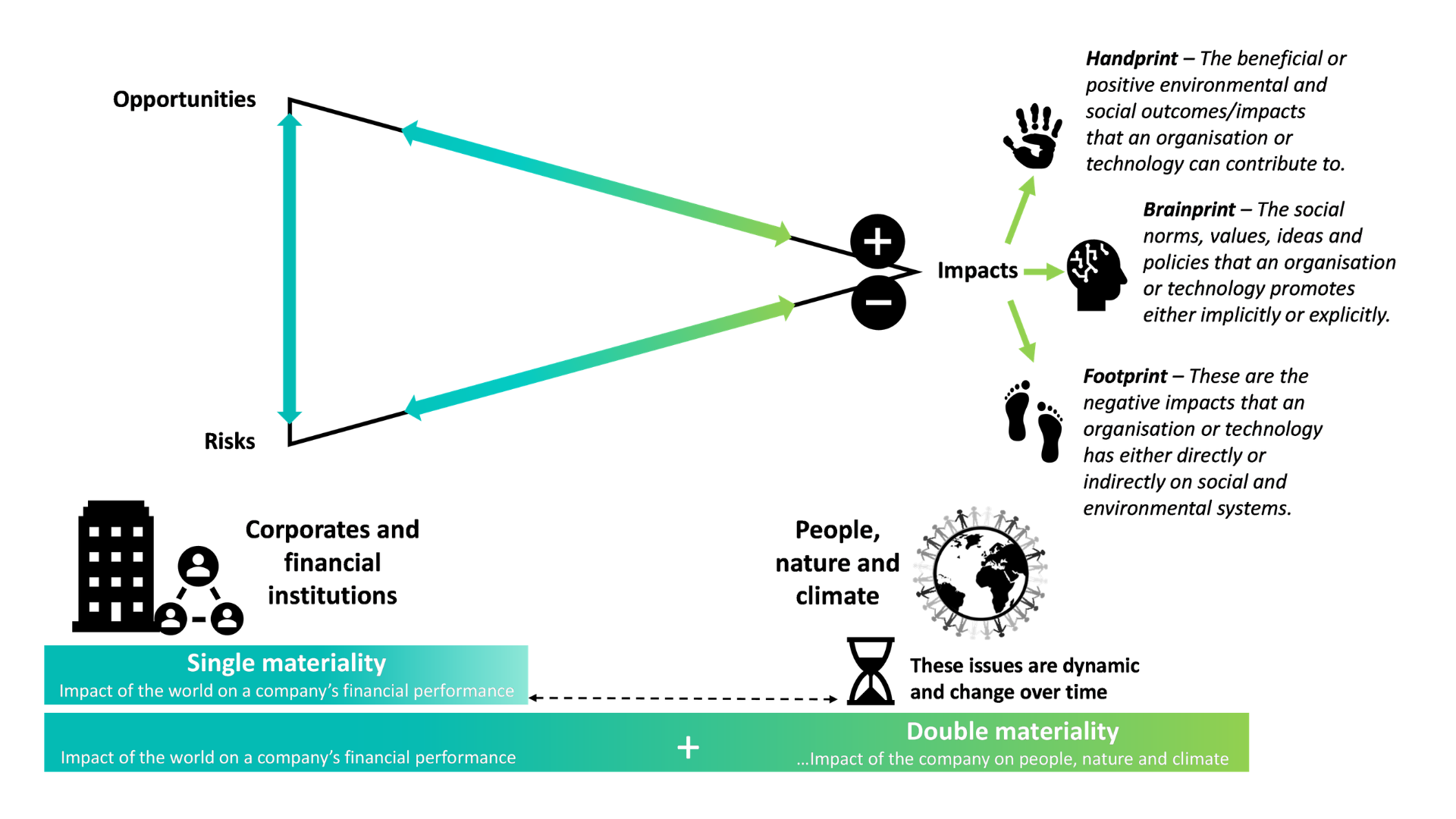
Source: Thomas Vergunst
UK regulators report that AI adoption was already widespread in financial services by the autumn of 2024: 75% of UK firms were already using AI and 55% of AI use cases were reported to involve some degree of automated decision-making. These figures will no doubt be a lot higher today.
AI can improve productivity, accelerate scientific discovery and reduce the cost of some services. Penn Wharton, for instance, estimates that AI could lift US productivity and GDP by 1.5% by 2035, with larger cumulative gains over the following decades. Researchers and firms are already using AI to speed advances in areas from protein science to product design.
But that is only half the story.
The first challenge is that the economic upside is uncertain and uneven. Stanford researchers have found that workers aged 22 to 25 in the most AI-exposed occupations have experienced a notable relative decline in employment since ChatGPT was launched in November 2022. Elsewhere, an MIT study notes that AI is not yet yielding any productivity gains despite US$30-40 billion in enterprise investment into generative AI.
The second challenge is operational and systemic risk. The Financial Conduct Authority has warned that AI in retail financial services could bring algorithmic bias, opaque decision-making, fraud, reduced consumer agency, market concentration and new forms of systemic vulnerability. As such, the deployment of AI within UK financial institutions is already facing greater regulatory scrutiny.
This is where a sustainability lens helps: it reminds us that social and environmental impacts and externalities, are not “non-financial” for very long.
Take energy and water. The International Energy Agency projects that global electricity use by data centres will more than double to around 945 TWh by 2030, with AI as the main driver of growth. Indeed, AI is already driving up electricity prices for US citizens. Separate academic research
suggests that, without mitigation, global water consumption associated with data centres could rise more than sevenfold by mid-century. These issues will drive future cost pressures and are already leading to community opposition and political intervention.
For UKSIF’s members, that means stewardship and analysis needs to evolve. Investors should press companies on the quality of AI governance, not just the scale of AI ambition. They should interrogate workforce impacts, third-party dependencies, explainability, energy sourcing, water use and consumer outcomes. They should also resist simplistic narratives: AI poses an existential threat for both democracies and totalitarian states if not carefully managed. This should act as a major wake up call for investors who are concerned about the long-term stability of our economies.
Sustainable finance is useful precisely because it trains us to see second and third-order effects before they become first-order losses. It also requires us to take responsibility for how we are stewarding capital through time and the fact that our investments are creating the future that our children will inherit.
What kind of world will my son be retiring into if he even has a job to retire from? I’m sure, like me, he will not only be concerned about the size of his pension pot but also about the quality of life that he is able to lead with the savings he has.
AI will be one of the defining investment themes of the next decade as we shift from the ‘attention economy’ of the social media age to the ‘intimacy economy’ of the AI age. Financial institutions need to not only focus on the deployment of AI internally, but also how they are financing its deployment within society. We best get this right.
That is why we’ve worked with UKSIF to launch the accredited Sustainable Finance Foundations: Banking, Investment and Insurance short course to help you, your team and peers develop a crucial understanding of the risks of the global sustainability crisis and opportunities for a sustainable transition in your work. Book your place today and ask about group discounts here.
The views expressed on these pages are the opinions of their respective author(s) only and do not necessarily reflect the views and opinions of UKSIF.
This website should not be taken as financial or investment advice or seen as an endorsement or recommendation of any particular company, investment or individual. While we have sought to ensure information on this site is correct, we do not accept liability for any errors.