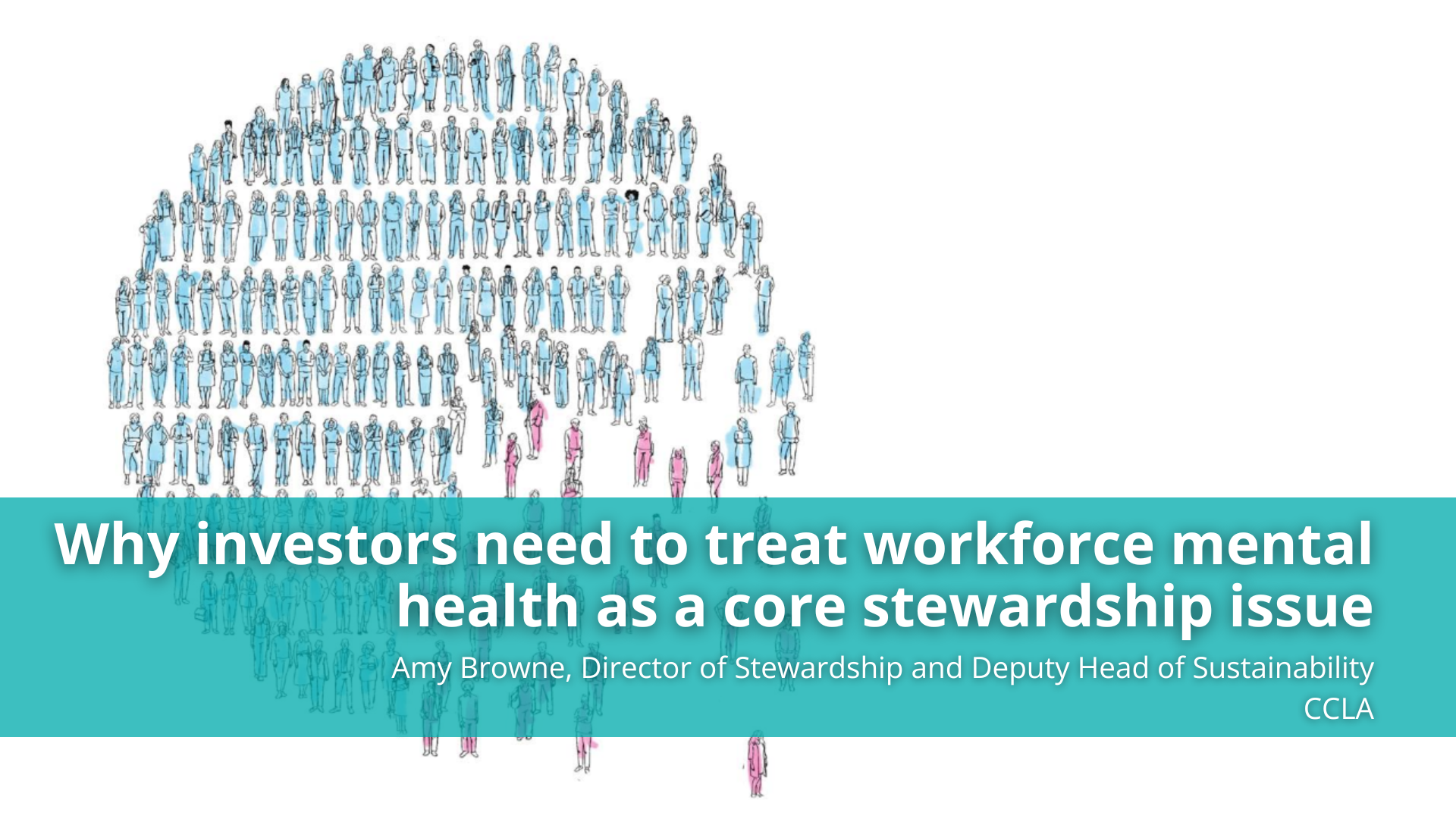
Why investors need to treat workforce mental health as a core stewardship issue
Amy Browne, Director of Stewardship and Deputy Head of Sustainability, CCLA

Note: The views expressed on these pages are the opinions of their respective author(s) only and do not necessarily reflect the views and opinions of UKSIF.
This website should not be taken as financial or investment advice or seen as an endorsement or recommendation of any particular company, investment or individual. While we have sought to ensure information on this site is correct, we do not accept liability for any errors.
Why investors need to treat workforce mental health as a core stewardship issue
Amy Browne, Director of Stewardship and Deputy Head of Sustainability, CCLA
For CCLA, stewardship sits at the intersection of client priorities and long term value at risk. We believe that companies with strong sustainability and governance practices are best positioned to serve the interests of all stakeholders. Such companies demonstrate greater resilience to regulatory change, shifting consumer behaviour and long term challenges such as climate change.
Our stewardship team engages with companies across a wide spectrum of systemic and financially material issues, from climate resilience and labour standards to workplace culture and human rights. Increasingly, one issue cuts across all others: the mental health and wellbeing of the workforce.
For years, mental health was treated as a ‘soft’ topic, something for human resources departments to dip into at the margin. But the data tells a very different story. Poor mental health costs employers an estimated £1,800 per employee per year, and for a company the size of Amazon, that equates to an estimated £2.7 billion in lost productivity. Meanwhile, the return on investment for effective mental health interventions is estimated at £4.70 for every pound spent (Deloitte 2024). These are not marginal figures. They are financially material, strategically significant, and measurable.
Why we created the CCLA Corporate Mental Health Benchmark
When we launched the CCLA Corporate Mental Health Benchmark in 2022, our aim was simple: to bring transparency, accountability, and ambition to an area that had long lacked all three. We wanted to give investors a tool to assess how companies support their people, and to give companies a roadmap for improvement.
Since then, the benchmark has become a powerful catalyst for change. We have now published eight rankings over four years, conducting annual assessments and public league tables that shine a light on corporate performance. The investor community has rallied behind this work: our global investor coalition now represents $9.5 trillion in assets, signalling that mental health is firmly on the stewardship agenda.
The results speak for themselves. Seventy four companies have improved their ranking, including 13 that have moved up two tiers and three that have climbed three tiers. Collectively, these improved companies employ 5.3 million people worldwide. That is real world impact at scale.
What the latest benchmark tells us
The findings from 2025 reveal a tale of two markets. In the UK, we are seeing genuine momentum. Companies are increasingly embedding mental health into governance structures, reporting frameworks, and leadership priorities. The global cohort, by contrast, is more geographically diverse and heavily weighted toward the US, where progress is uneven.
There are standout improvers; companies that have made remarkable strides in transparency, leadership commitment, and workforce engagement. But there are also areas of concern. Several of the so called ‘magnificent seven’ companies that dominate global indices and shape the digital economy sit at the bottom of our ranking. They are extraordinary businesses, but our data suggests they are not yet extraordinary places to work.
The healthcare sector also presents a mixed picture. Novartis, Roche, Novo Nordisk, and Johnson & Johnson are working hard to improve, demonstrating that large, complex organisations can lead on mental health. Yet AstraZeneca has deteriorated more than any other company, falling 25 percentage points since its first assessment. As stewards, we respond accordingly. In AstraZeneca’s case, we escalated our concerns and voted against the CEO at its annual general meeting: a clear signal that in our view, mental health is not just a peripheral concern, but central to the company’s long-term resilience.
How companies can improve
For organisations seeking to strengthen their approach to workforce mental wellbeing, three practical steps stand out:
1. Leadership commitment
Senior leaders must set the tone. Mental health should be visible in strategy, governance, and reporting, and not confined to internal wellbeing campaigns.
2. Good working conditions
Workload, job design, autonomy, fair pay, and psychological safety matter. Companies must address the root causes of ill-health, not just offer support once people are struggling.
3. Measurement and management
Companies should track wellbeing, respond to findings, and build resilience through training, listening, and continuous learning.
Why the benchmark works
The success of the benchmark reflects several factors: the financial case for action, the credibility of the methodology, its alignment with WHO and ILO standards, peer competition, strong investor collaboration, and sustained media attention. Together, these elements create a powerful incentive for companies to improve.
That said, every company is different. One wanted to be recognised as a global business that genuinely cares about its employees. Another was responding to tragic employee suicides. A third recognised that our advice was sound and saw no reason not to act. A fourth was tackling negative media coverage. All of them understand the same truth: supporting mental health boosts productivity, reduces turnover and sickness absence, and strengthens their appeal to current and future employees.
As investors, we cannot afford to ignore the wellbeing of the people who create corporate value. Mental health is not a ‘nice to have’, but a strategic imperative. Through stewardship, transparency, and collaboration, we can help to ensure that companies treat it that way.
The views expressed on these pages are the opinions of their respective author(s) only and do not necessarily reflect the views and opinions of UKSIF.
This website should not be taken as financial or investment advice or seen as an endorsement or recommendation of any particular company, investment or individual. While we have sought to ensure information on this site is correct, we do not accept liability for any errors.