When screens fail: Stewardship in a geopolitical era
Mathieu Joubrel, Co-Founder and COO, ValueCo

Note: The views expressed on these pages are the opinions of their respective author(s) only and do not necessarily reflect the views and opinions of UKSIF.
This website should not be taken as financial or investment advice or seen as an endorsement or recommendation of any particular company, investment or individual. While we have sought to ensure information on this site is correct, we do not accept liability for any errors.
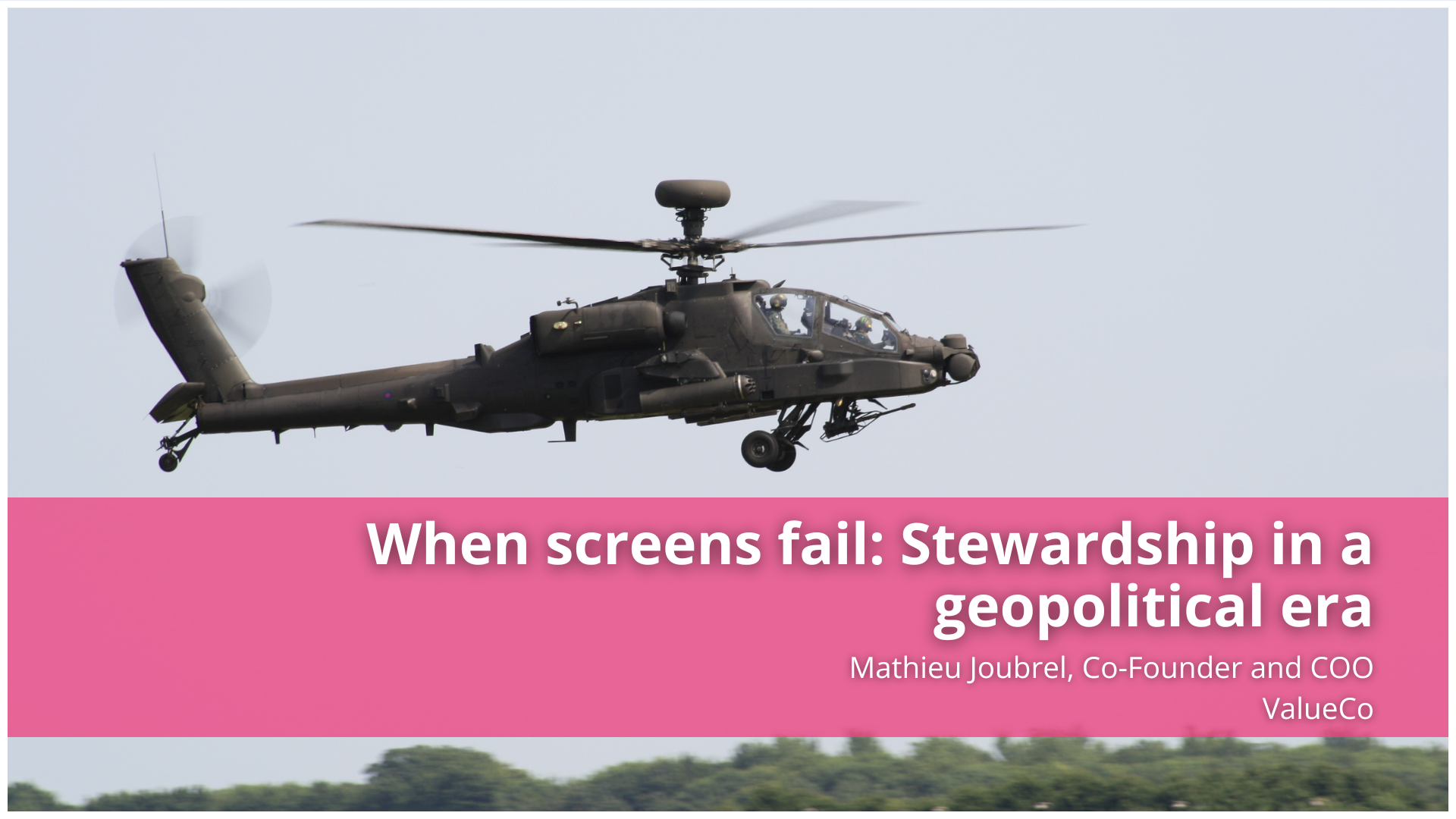
When screens fail: stewardship in a geopolitical era
Mathieu Joubrel, Co-Founder and COO, ValueCo
For much of the past decade, the defence sector has been widely regarded as incompatible with sustainable investing. Ethical exclusions, screening methodologies, and sustainability-labelled funds have largely positioned defence companies as structurally hard to include in responsible strategies, associated with controversial products, human rights concerns, and environmental risks. For investors seeking alignment with sustainability principles, exclusion appeared to offer a clear and principled solution.
Recent geopolitical developments have disrupted that consensus. The wars in Ukraine and Iran, rising security threats across Europe, and renewed emphasis on strategic autonomy have forced investors and policymakers to reconsider the role of defence in their portfolios. Even though defence budgets are rising and security is increasingly framed as a public good, the means used to provide it still create severe externalities that must be properly governed, not merely rebranded. This reassessment does not signal a retreat from responsible investing, it rather raises the bar. As exclusions prove insufficient to address complex trade-offs, stewardship has emerged as the central mechanism through which investors seek to manage geopolitical risks. Defence is not ESG-compliant by default, and exposure remains conditional on red lines, controls, and escalation strategies.
Underperformance, exclusion, and the limits of ratings
Quantitative analysis consistently shows defence manufacturers scoring poorly on climate mitigation and human rights risk indicators relative to the broader corporate universe, driven by structural features of the sector: industry-heavy production, end-use uncertainty, opaque customer bases, and concentrated supply chains. At end-2023, 74% of global climate-transition fund assets tracked EU climate benchmarks restricting exposure to companies involved in controversial weapons, and across SFDR-classified funds, defence remains systematically underrepresented relative to market capitalisation. These exclusions are not arbitrary, they reflect real risks that investors are unwilling to ignore. From a stewardship perspective, however, underperformance serves a second function: identifying where risks are concentrated and where investor expectations are likely to focus. Climate impacts, human rights safeguards, governance quality, and compliance with international conventions consistently emerge as the most material dimensions for defence companies.
The methodology producing these assessments is nonetheless structurally flawed. ESG ratings penalise defence through coarse sector classifications and controversy flags, often without adequately differentiating between prohibited activities and legitimate defensive roles, and without capturing whether risk management is improving. Security’s social consequences are almost entirely absent from rating models, meaning ratings can reinforce exclusionary outcomes even where selective engagement would be more effective. In sectors characterised by inherent risk and ethical complexity, a score cannot tell you whether risks are unmanaged, mitigable, or actively addressed.
From categorical judgement to conditional investability
On Bruegel’s estimates of European sustainable fund AUM, redirecting just 10% of Article 6 assets and 5% of Article 8 assets toward defence-eligible strategies would amount to roughly the EU’s investment target of €800 billion. It illustrates how classification and exclusion rules are the binding constraint rather than any shortage of capital. The tension here is not sustainability versus security, but low-information capital allocation versus well-governed, conditional exposure, and that reframing points directly to stewardship as the operative instrument.
Rather than asking whether defence is ESG-compatible in the abstract, rigorous investors are asking more specific questions: which activities are prohibited under international law, which risks require mitigation, and which governance standards are non-negotiable. This moves the analysis from binary inclusion or exclusion toward conditionality. Clear red lines remain essential, particularly for activities prohibited under international humanitarian law. Between exclusion and endorsement, however, lies a growing space where engagement can define the investment relationship.
What stewardship requires in practice
In practice, engagement with defence companies is less about relabelling and more about hardening controls. Investors expect board-level mandates for product governance and export controls, clear end-use and customer screening frameworks, incident disclosure with remediation KPIs, independent assurance of compliance systems, and supplier due diligence across high-risk tiers. Governance is the first test: weak board oversight is typically interpreted as a signal that other ESG risks are unlikely to be effectively managed. Where disclosure is constrained by legitimate security considerations, credible independent assurance of controls is the minimum acceptable substitute. Stewardship also makes assessment dynamic, requiring measurable trajectory, 12 to 24 month milestones, and a clear escalation path if progress stalls.
Defence is a stress test for responsible investment’s next phase: less comfort from screens, more discipline through stewardship. Geopolitics does not relax standards; it forces explicit red lines, verified controls, and escalation. That discipline applies equally to any strategically sensitive sector where risks are inherent but governable, including energy, utilities, and telecommunications. For asset owners and managers, the implication is practical: context-led materiality assessment, explicit engagement objectives, and transparent escalation. Stewardship, applied rigorously, is how sustainability principles translate into responsible strategies rather than into capital allocation that is principled in appearance but blunt in practice.
The views expressed on these pages are the opinions of their respective author(s) only and do not necessarily reflect the views and opinions of UKSIF.
This website should not be taken as financial or investment advice or seen as an endorsement or recommendation of any particular company, investment or individual. While we have sought to ensure information on this site is correct, we do not accept liability for any errors.