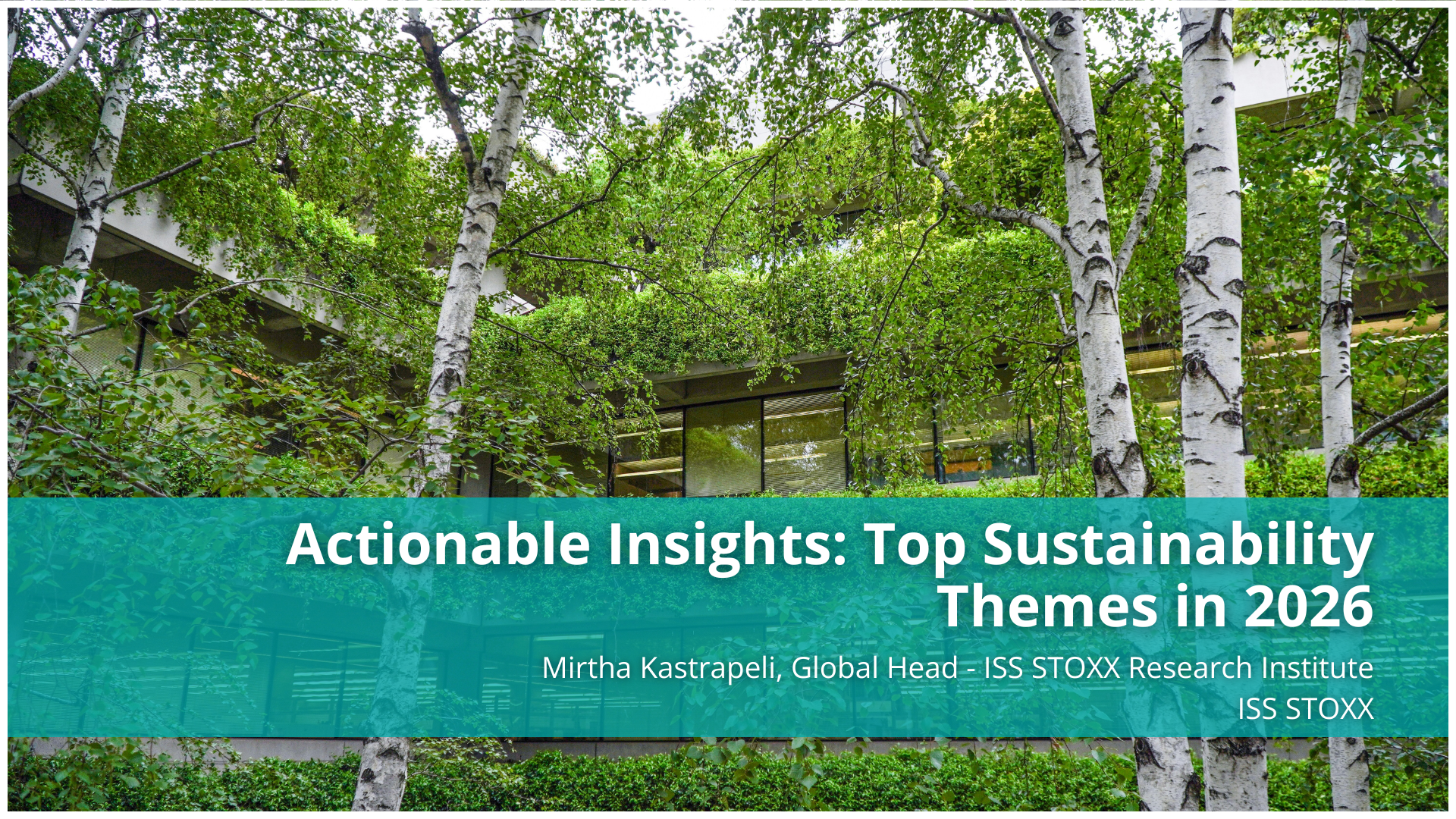
Actionable Insights: Top Sustainability Themes in 2026
Mirtha Kastrapeli, Global Head – ISS STOXX Research Institute, ISS STOXX

Note: The views expressed on these pages are the opinions of their respective author(s) only and do not necessarily reflect the views and opinions of UKSIF.
This website should not be taken as financial or investment advice or seen as an endorsement or recommendation of any particular company, investment or individual. While we have sought to ensure information on this site is correct, we do not accept liability for any errors.
Actionable Insights: Top Sustainability Themes in 2026
Mirtha Kastrapeli, Global Head – ISS STOXX Research Institute, ISS STOXX
The year 2025 was marked by an unprecedented rise in global economic policy uncertainty and some regulatory headwinds for sustainable investment. The new year is set to be one of pragmatism, as investors continue to expand and refine their analysis of their portfolio companies’ business case for sustainability.
The ISS STOXX annual global outlook report, Actionable Insights: Top Sustainability Themes in 2026, highlights this pragmatism. In this report, we focus on the climate change preparedness of public companies, physical risk analysis using geospatial asset level data, AI governance, regulatory developments around labor rights, and data about investment flows into sustainable funds.
On climate preparedness, we propose a deeper analysis of companies’ ability to assess and manage climate risk that goes beyond traditional emissions data and targets, which tell only half the story. By examining governance, disclosure, and implementation indicators (such as management’s role in climate assessments, climate risk reporting in financial accounts, and capital allocation), investors can better assess the credibility of companies’ climate preparedness.
This highlights that while 74% of the companies assessed overshoot their 2030 carbon budgets, only 42% are considered “unprepared.” Being unprepared means that these companies not only overshoot their stated carbon budgets but also exhibit weak organizational readiness. For portfolio construction, the emissions-only approach potentially excludes all companies that overshoot their budgets, regardless of their organizational capacity. That removes from consideration “transition leaders”: companies that overshoot their budgets yet have strong governance structures.
Our analysis also shows that 17% of companies are considered “Best Positioned”: they simultaneously both meet their carbon budgets and demonstrate strong governance and operational readiness. These companies are best prepared as transition pressure intensifies and organizational infrastructure becomes more visible.
We also examined physical climate and nature risk across different scenarios and time horizons. Specifically water stress and heat wave risk in data centers using geospatial data. Based on granular data covering 100 assets globally, heat stress is expected to intensify: 43 data centers face medium or high risk in the next 15 years, rising to 64 over 30 years. Heatwaves increase cooling demands and lead to higher outage risks, operational costs, and need for infrastructure upgrades.
Another area of focus is Artificial Intelligence (AI). AI will likely continue to drive global markets’ momentum, yet investors’ questions around AI governance are also likely to intensify. Our research introduces the concept of Ethical AI, which reflects broad values and principles—such as data protection and transparency—aimed at enhancing AI’s benefits while reducing risks. Other crucial concepts are Responsible AI, which defines how Ethical AI principles are operationalized; and Just AI, which focuses on AI’s societal and economic impacts, ensuring fair and balanced outcomes for all stakeholders. Analysis of corporate disclosures from leading technology companies—the “Magnificent 7”—shows that most articulate Ethical AI values, but fewer translate them into Responsible AI governance frameworks or address the human implications central to a Just AI transition.
On the social side, we have analyzed regulatory developments in labor rights. Multinational companies, which are often part of extensive value chains, must navigate a range of labor regulations directly applicable to their operations while conducting effective due diligence over suppliers. This process may grow more complicated, as labor regulation in several jurisdictions is moving toward more stringent due diligence requirements. Data from ISS STOXX Corporate Ratings show significant or notable room for improvement across all labor-related disclosures under the Supplier Social Standard. Low levels of disclosure expose these companies to reputational, legal, and financial risks.
Finally, we reviewed the resilience of sustainable investment during 2025, notwithstanding lingering regulatory headwinds. This relative strength is evident in sustainable ETF flows globally, which have continued to grow at a rate comparable to the overall ETF market. Based on ISS MI MarketPulse data, Sustainable ETF AUM as of September stood at $631 billion, up 18% since December 2024. Further, while results differ across index methodologies, sustainability indices have often shown resilience and sometimes outperformance, particularly in European indices.
2026 is set to be a year of pragmatism in the sustainable investment space. More granular data, more rigorous models, and deeper industry-specific insights can help investors better assess the business case for sustainability.
The views expressed on these pages are the opinions of their respective author(s) only and do not necessarily reflect the views and opinions of UKSIF.
This website should not be taken as financial or investment advice or seen as an endorsement or recommendation of any particular company, investment or individual. While we have sought to ensure information on this site is correct, we do not accept liability for any errors.
Read More